The share of renewable energy sources in the EU is increasing.
When does the EU want to be climate neutral?
Most experts warn about problems that arise due to our environmentally unfriendly behavior toward the planet. Our long-term, irresponsible behavior is pushing the whole world toward an ecological catastrophe. The EU does not take these warnings lightly, and therefore it has begun setting ambitious goals to achieve climate neutrality. The Union plans to incorporate elements of the green economy into every sector of the economy. By 2050, it wants to achieve climate neutrality, and by 2030 it plans to reduce greenhouse gas emissions by 55% compared to 1990. With these steps, it is trying to reverse the negative trend and stop the release of pollutants into the environment. These pollutants cause global warming, worsening air quality, water pollution, and the extinction of animals and insects. Just to give an idea, in Europe more than 300,000 people die each year as a result of poor air quality.
Is the EU close to its goal?
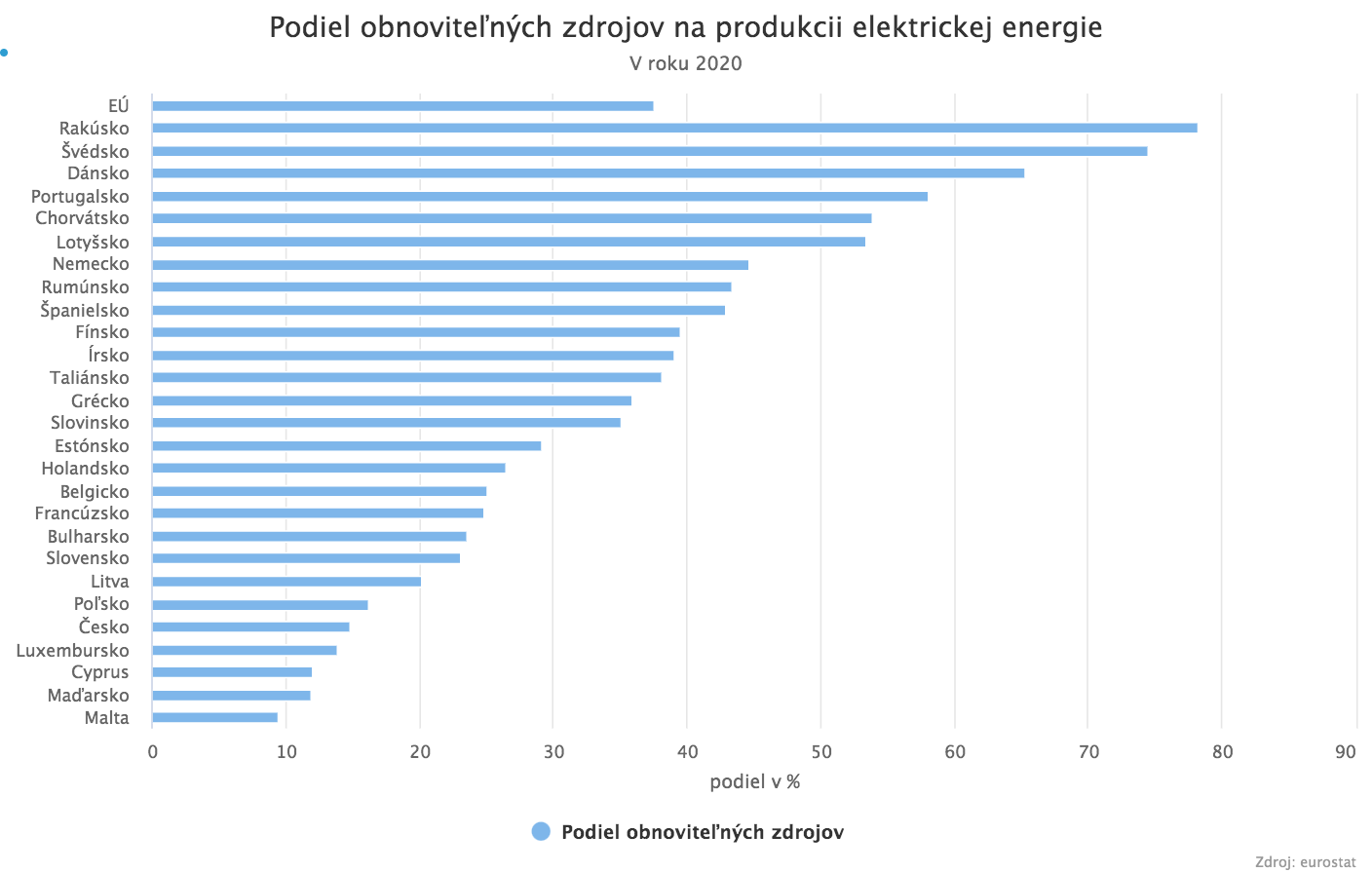
Many EU citizens do not even realize how large a share of electricity comes from renewable sources. Thanks to strong support for the green economy, this figure has been rising every year and today it has reached 37%. The largest share of electricity comes from wind power plants, at 36%; hydropower dams account for 33%; solar power plants produce 14%; biofuels provide 8%; and other sources make up the remaining 8%. This is what the current energy mix for electricity generation from renewable sources in the EU looks like. However, not every country produces such a solid level of electricity from alternative sources. Austria is doing best, with as much as 78.2% of its electricity coming from clean production. Malta ranked worst, obtaining only 9.5% from these sources. Slovakia uses renewables to generate only about 23% of its electricity, which means we have outperformed our closest neighbors in the Czech Republic by around 8 percentage points.
Is the EU alone in this effort?
Definitely not, since almost the entire world has signed the Paris Agreement, which aims to significantly reduce the world’s carbon footprint. The biggest polluters include the United States and China, with China being the largest in the world. China would like to reach the peak of its pollution by the end of this decade, and it wants to be climate neutral by 2060. The United States is the second-largest producer of greenhouse gases, and under Donald Trump’s administration it withdrew from the Paris Agreement. The president himself was among those who downplayed this important issue, and therefore he was not willing to support investments in the green economy. However, the situation changed with the arrival of a new president, who immediately rejoined the agreement. In addition, in the U.S. the bulk of investments from fiscal stimulus packages to support the economy after the pandemic should be directed into the green economy and infrastructure. The United States expects that by 2050 it will generate 42% of its electricity from clean sources. Currently, it produces about 21% of its electricity from alternative sources. Asia and the Pacific are not waiting either, and just last year they invested USD 368 billion in this sector, which is an increase of 38% compared to 2020. Of this total amount, China alone accounted for USD 266 billion, which is a 60% increase compared to 2020. Overall, the entire world invested USD 755 billion in the green economy last year, which is 27% more than in 2020. These figures show how the whole world has come together and begun addressing the planet’s ecological problem. Globally, the world generates approximately 29.6% of its electricity from sources other than conventional ones.
Investors Sense an Opportunity
Capital markets have always liked new and innovative companies, and companies operating in renewable energy sources are undoubtedly among them. As governments increase investments in the green sector year after year, investors began speculating about how to profit from this global problem. The year 2020 and the beginning of 2021 were truly favorable for these companies. From the pandemic low, the 30 largest companies in this sector gained more than 300%. Such crazy sector growth was, of course, unjustified and premature, since most companies in this sector are spending huge resources on building power plants and profits are still nowhere in sight. It is important to realize that this sector still has a long road ahead and must be supported by governments so that it can eventually replace conventional energy sources and achieve the desired profit. However, blinded investors became so consumed by this topic that they poured billions of dollars into loss-making firms. Currently, the index of the 30 largest companies in the clean energy sector has fallen by more than 45% from its peak, which, according to analysts, is creating an opportunity for long-term investors to build a position.
Negative impact of the transition to renewable energy sources
Every change has its positives and negatives. In this case, the negatives are mainly financial, along with the shortcomings of some clean energy sources. Not every plot of land is suitable for a wind power plant, since wind strength and duration are key parameters. In addition, there are issues with recycling turbine blades and with bird mortality. Solar panels, in turn, require long sunny days and lose significant performance during the winter months. Hydroelectric dams alter rivers and prevent the free movement of fish. Moreover, all of these sources tend to be less efficient than conventional ones, which is why we need a larger number of alternative power plants. This is precisely why a discussion was held at the European level, resulting in the temporary acceptance of energy from nuclear and gas power plants. The most pressing problem of this global shift is the price of energy, which is significantly higher than what we are used to. Today, this problem is even more pronounced because the EU is suffering from a sharp rise in the prices of gas, coal, and oil. Gas and coal are still important commodities for electricity generation, and as a result we are witnessing turbulence in the energy market. Another issue is emissions allowances (permits), whose price keeps rising and for which demand is high from both industry and power plants. Another problem is speculative investors who buy up permits and wait for prices to rise.
Solutions to this crisis
So far, the world has no other option than to continuously invest in renewable energy sources and improve their performance. Only in this way can humanity live on the planet sustainably and in harmony over the long term, and thus prosper in all aspects of life. This will require not only investments from governments, but also people’s willingness to temporarily pay more for clean energy than they are used to, thereby supporting the transition. Technological progress in the future will solve issues related to recycling, energy storage, and the efficiency of production. This transition simply needs time and the determination to stick to the set goals, even at the cost of higher expenses.