The FOMO Effect: Do Emotions Run the Investment World?

The FOMO effect
FOMO, short for fear of missing out, is a psychological phenomenon driven by the emotional perception that a once-in-a-lifetime opportunity is slipping away, while others are already benefiting from it. When markets rise, many investors experience anxiety and rush into speculative positions without a clear plan. The common driver is the prospect of quick profits in equities or other assets.
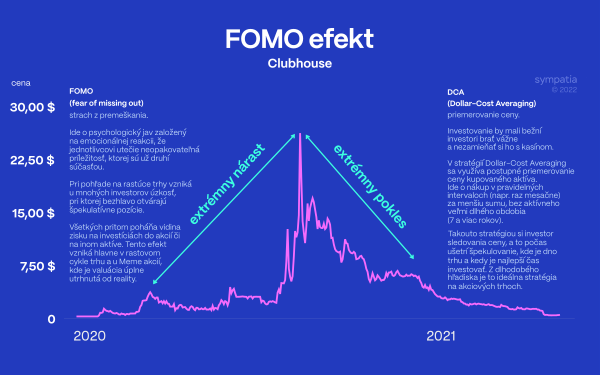
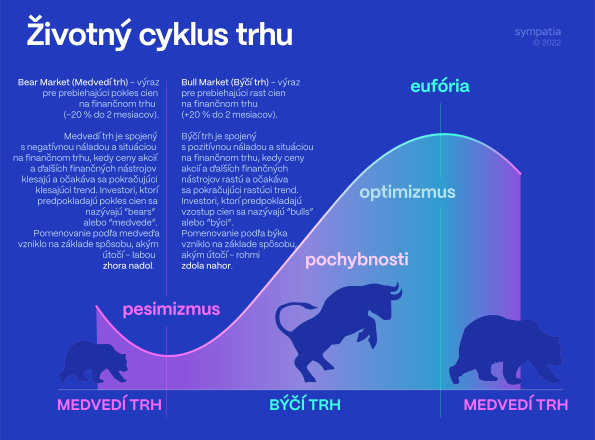
FOMO tends to emerge most strongly during bullish phases of the market cycle, and it is particularly visible in “meme stocks,” where valuations become completely detached from fundamentals. For retail investors, participating in financial markets should be approached with discipline and seriousness, not as if it were a casino, where most participants ultimately lose. This is precisely why it is often advisable for retail investors to allocate surplus capital to well-constructed, responsibly managed portfolios, whether passive (index-based) or actively managed.
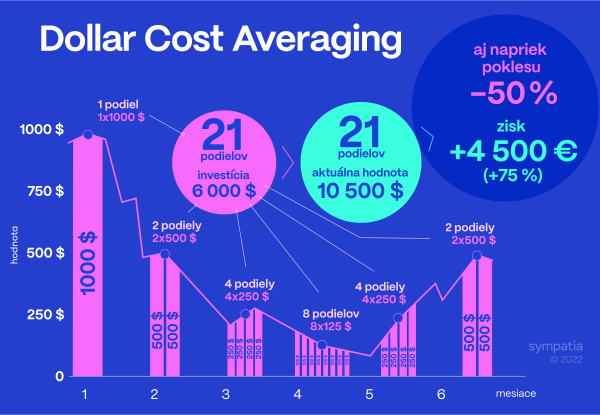
A practical approach is dollar-cost averaging (DCA): investing smaller amounts at regular intervals (for example monthly) over a long time horizon (typically seven years or more).
How it works in practice
Dollar-cost averaging relies on gradually averaging the purchase price of the chosen asset. The investor buys systematically across market regimes, during rallies, drawdowns, and sideways periods alike, resulting in an averaged cost basis over time. This reduces the need to time the market, removing the temptation to speculate about where “the bottom” is or when the “best moment” to invest might be. Over the long run, DCA has proven particularly suitable for equity-market exposure.
Investors still want to take risk
Even though most analysts recommend long-term, rules-based investing for retail participants, many retail investors remain tempted by risk-taking. After the COVID-driven sell-off, FOMO and greed were among the key forces behind the subsequent surge in equities.
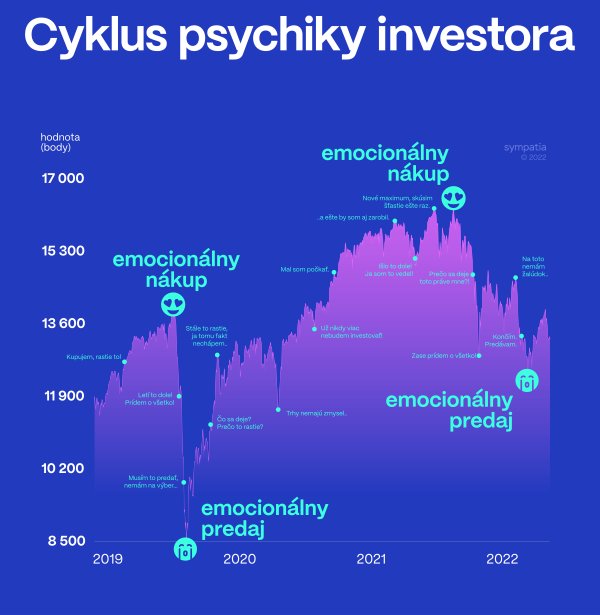
Following the initial decline, investors panicked, but once they saw indices rebound, many re-entered the market aggressively, afraid of missing the recovery. In some cases, this created extreme distortions that later culminated in sharp sell-offs in growth stocks.
In recent weeks, markets have seen significant capitulation in growth-oriented names, which were likely “oversold.” Interestingly, despite the wide range of opportunities across capital markets, many investors continue to hesitate out of fear. In hindsight, they will often say, “I should have bought there,” but in real time they do nothing because they succumb to psychological pressure.
It is reasonable to expect that the same cohort could re-enter aggressively if equities resume a strong uptrend, once again driven by the fear of missing further gains.
Greed always wins, until it doesn’t
“Just a bit more and then I’ll sell.” This is one of the most common phrases heard during asset bubbles. Investors are often willing to risk the bulk of their profits for a few additional percentage points, even though the risk of a reversal is typically highest in the final stretch. When the investment corrects, the investor is no longer willing to sell at a smaller profit, because they “used to have” a much larger one. Too often, what could have been a modest gain turns into a significant loss.
Groupthink and confirmation bias
A frequent market dynamic is groupthink, where a large crowd converges on the same view and alternative interpretations are crowded out. Groupthink can lead to errors, because investors reinforce each other’s beliefs and dismiss dissenting information. This occurs both in asset bubbles and during severe market drawdowns.
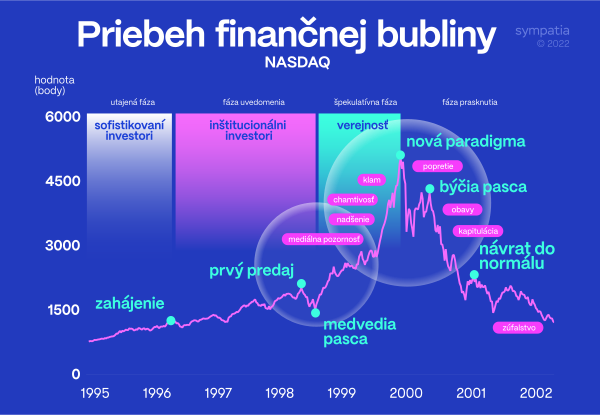
Investors should avoid herd behavior and blind trust in the dominant market narrative. Instead, they should rely on disciplined analysis and a long-term framework.
A related phenomenon is confirmation bias, which occurs when investors seek and interpret information selectively, in ways that support their existing thesis. An investor should continuously reassess new information about the instruments they own and evaluate it objectively, without “bending” reality to fit the original story.
It is often said that the largest component of success in markets is psychological resilience. That resilience is constantly tested. Consider Amazon, which fell by more than 90% during the dot-com bubble, at which time most would have called it a disastrous investment (and within that bubble, it arguably was). Yet from its trough, Amazon rose by roughly 39,000%. The example illustrates the level of psychological fortitude required when an investor has high conviction, supported by rigorous analysis, and can remain rational through volatility.
Fear as the investor’s greatest enemy
Many experienced investors have historically bought during periods of panic, rather than waiting for clear bottoms or “confirmation” of a reversal. Their approach combines psychology with fundamental analysis, and over time it has often delivered strong results.
As Shelby Cullom Davis put it: “You make most of your money in a bear market, you just don’t realize it at the time.” Of course, it is difficult to add exposure when an investment is falling in value, but if the underlying investment thesis remains intact, what has changed may be price and sentiment, not fundamentals.
At the same time, investors should recognize the opposite case as well: when an investment is genuinely deteriorating, it may be prudent to exit and reallocate capital elsewhere. In any event, investing in equities is a long-distance run, and it is not suitable for individuals for whom market volatility would materially disrupt sleep or well-being. (See also the related article on meme stocks.)
Disclaimer
All texts, images, graphics, and other materials contained in this document are protected by copyright and may not be copied, distributed, modified, or provided to third parties without the prior written consent of Sympatia Financie, o.c.p., a.s. This document contains general information only. Sympatia Financie, o.c.p., a.s. does not provide professional advice or services through this document and assumes no responsibility for any loss or damage arising directly or indirectly in connection with any person relying on this document.