Biden Unveiled a $1.9 Trillion Economic Relief Plan

Joe Biden presented a broad economic relief plan six days before taking office as President, and it is set to be one of the priorities of his first months in office. This “American Rescue Plan” includes, for example, increasing direct one-time payments to residents to USD 2,000 per person, raising the minimum wage, and support for schools and small businesses. However, it is not certain whether he will be able to push it through in its current form. The initial market reaction was therefore lukewarm. Joe Biden introduced the long-anticipated large-scale plan for immediate economic relief. It is called the “American Rescue Plan” and totals USD 1.9 trillion. Biden will take office on January 20, and this plan is one of two main economic initiatives he wants to push through in his first months in office. The second package will include longer-term measures to repair the U.S. economy, and he will present its details in February. After last week’s victory in Georgia, Democrats hold the narrowest possible majority in the Senate, so in theory they have the votes to pass Biden’s plan quickly. In practice, however, this may be difficult, and these concerns are reflected in the market’s lukewarm initial reaction to the plan’s announcement.
Where will the aid go?
The largest share of the money from the American Rescue Plan will go toward increasing the direct one-time payment for (almost) all U.S. citizens by an additional USD 1,400 per person. The total amount of this payment, together with the USD 600 already approved in December, would thus reach as much as USD 2,000. The plan also includes raising the federal minimum wage to USD 15 per hour, increasing and extending unemployment benefits, and extending the eviction moratorium for nonpayment of rent. USD 30 billion will be allocated to help poor and unemployed people pay rent, USD 5 billion will go toward building emergency shelters for the homeless, and USD 3 billion for food assistance. An important part of the plan is also the allocation of USD 20 billion to create a national vaccination program and launch community vaccination centers. As much as USD 50 billion will go toward expanding testing capacity, and the plan also includes creating 100,000 jobs for healthcare workers and healthcare assistants. The plan also includes USD 175 billion in support for small businesses, primarily in the form of government-guaranteed loans. Another USD 350 billion will go to state and local governments, while USD 170 billion will be allocated to help schools reopen as soon as possible and do so safely.
High time
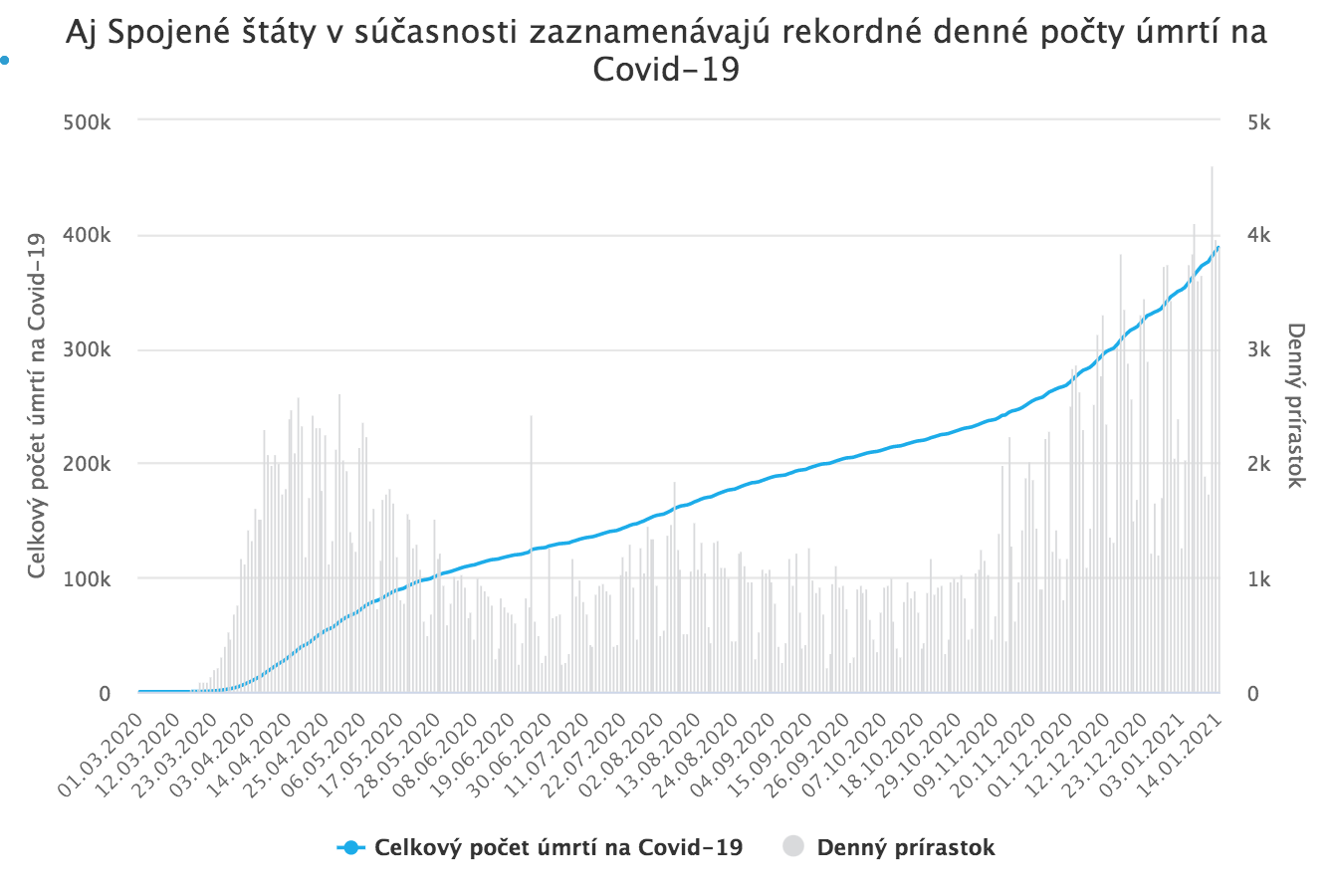
The form and exact scope of measures in the American Rescue Plan can be, and will be, debated, but most economists and experts from other fields agree that another support package for the economy is necessary, and its announcement was widely expected. The United States, like many other countries, is currently recording record daily numbers of COVID-19 deaths, and vaccination is not progressing at the desired pace.
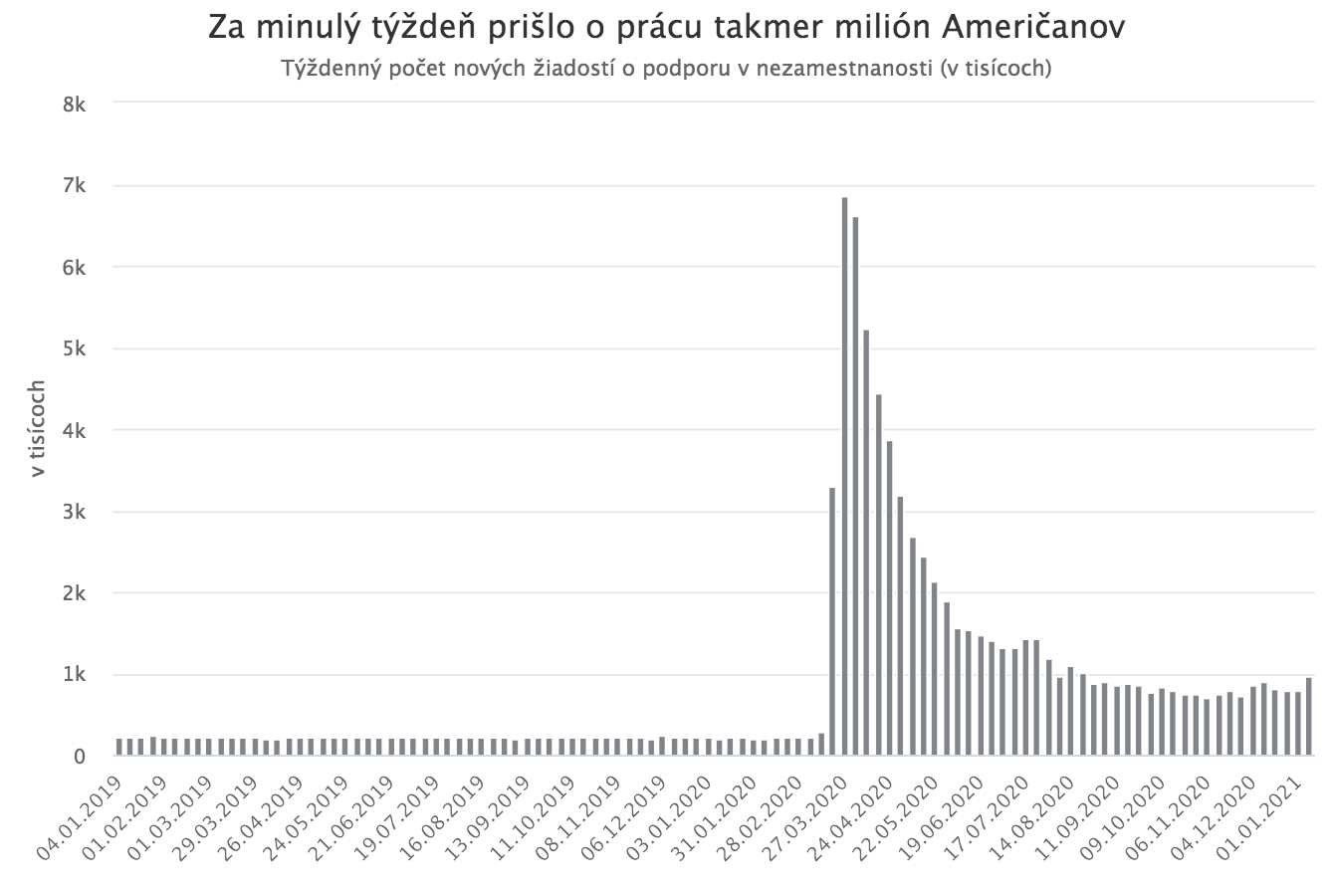
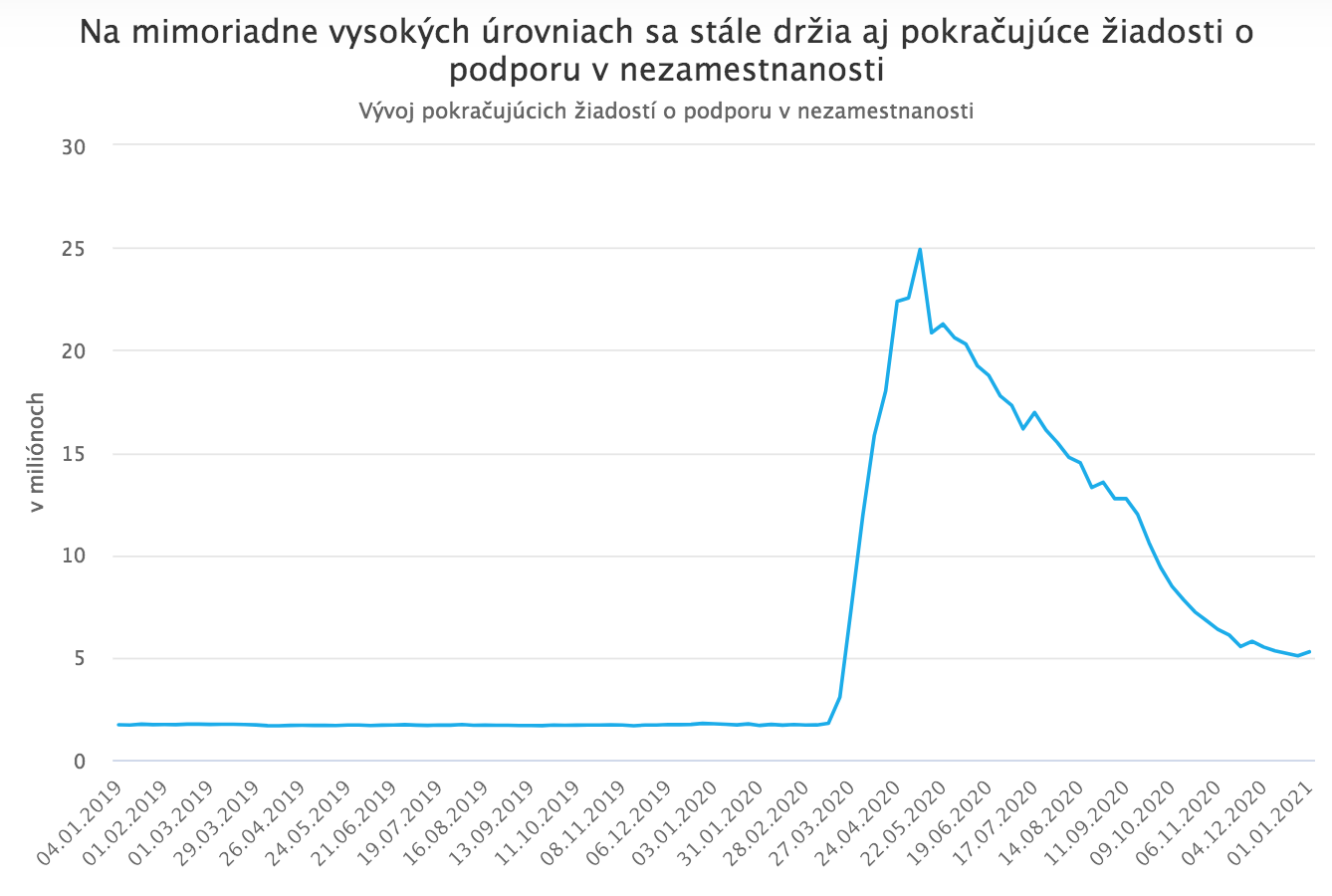
The urgency of adopting some form of economic relief was also underscored by U.S. labor market data released on the same day Biden presented his plan. They showed that almost 1 million Americans lost their jobs over the past week. This figure was not only significantly worse than expectations, but it also confirmed the worrying trend of a renewed deterioration in labor market conditions. New weekly unemployment claims have not fallen below the previous record from 1982 even once since the pandemic began. Continuing claims also remain at levels that were unimaginable before the pandemic. They currently stand at 5.27 million. Job losses have hit hardest in sectors with long-term lowest wages, and therefore have even worse social consequences. The Fed estimates that unemployment in the bottom quartile of the income distribution exceeds 20%.
Biden can count on the Fed’s support
The Fed, undoubtedly also in light of the data mentioned above, regularly speaks about the need for additional fiscal stimulus. Jerome Powell therefore almost certainly welcomed Biden’s plan and, on Thursday, even before it was published, made it clear during an online Q&A that the Fed will continue to support the economic recovery with all the tools at its disposal. Whatever problems arise in connection with Biden’s plan, it is practically certain that funding will not be one of them. The Fed is currently buying bonds worth USD 120 billion per month and is keeping interest rates at zero. Powell emphasized on Thursday that nothing will change in this policy in the foreseeable future, bond purchases will not be reduced, and interest rates will remain at their current record-low levels for the coming years. He also noted that the Fed is prepared to tolerate inflation rising above the 2% target for a period of time without tightening monetary policy. Ultimately, if it wants to give credibility to its new inflation strategy known as average inflation targeting, it has no other choice. It is therefore almost certain that the increased bond issuance that Biden’s plan could require will not lead to higher interest costs.
Lukewarm market reaction
Biden’s plan was not a surprise to investors. The announcement of a similar plan before he took office was widely expected. The only question was whether it would include some more controversial items and whether its size would differ significantly from the expected USD 2 trillion. At the same time, the expected unveiling of this plan supported the pro-cyclical rotation, which began in November and, after last week’s Democratic victory in Georgia, gained a second wind. The day before Biden’s appearance, it was again primarily small-company stocks in cyclical sectors and value stocks that rose. Shares of large growth companies in defensive sectors, led by big technology firms, lagged behind. As a result, the performance gap between shares of the largest tech companies (represented by the NYSE FANG+ index) and value stocks of small U.S. companies (represented by the Russell 2000 Value index) has exceeded 7% since the start of the year. The heavy weight of large tech stocks is also dragging down the U.S. benchmark S&P 500, which is essentially flat compared to the start of the year.
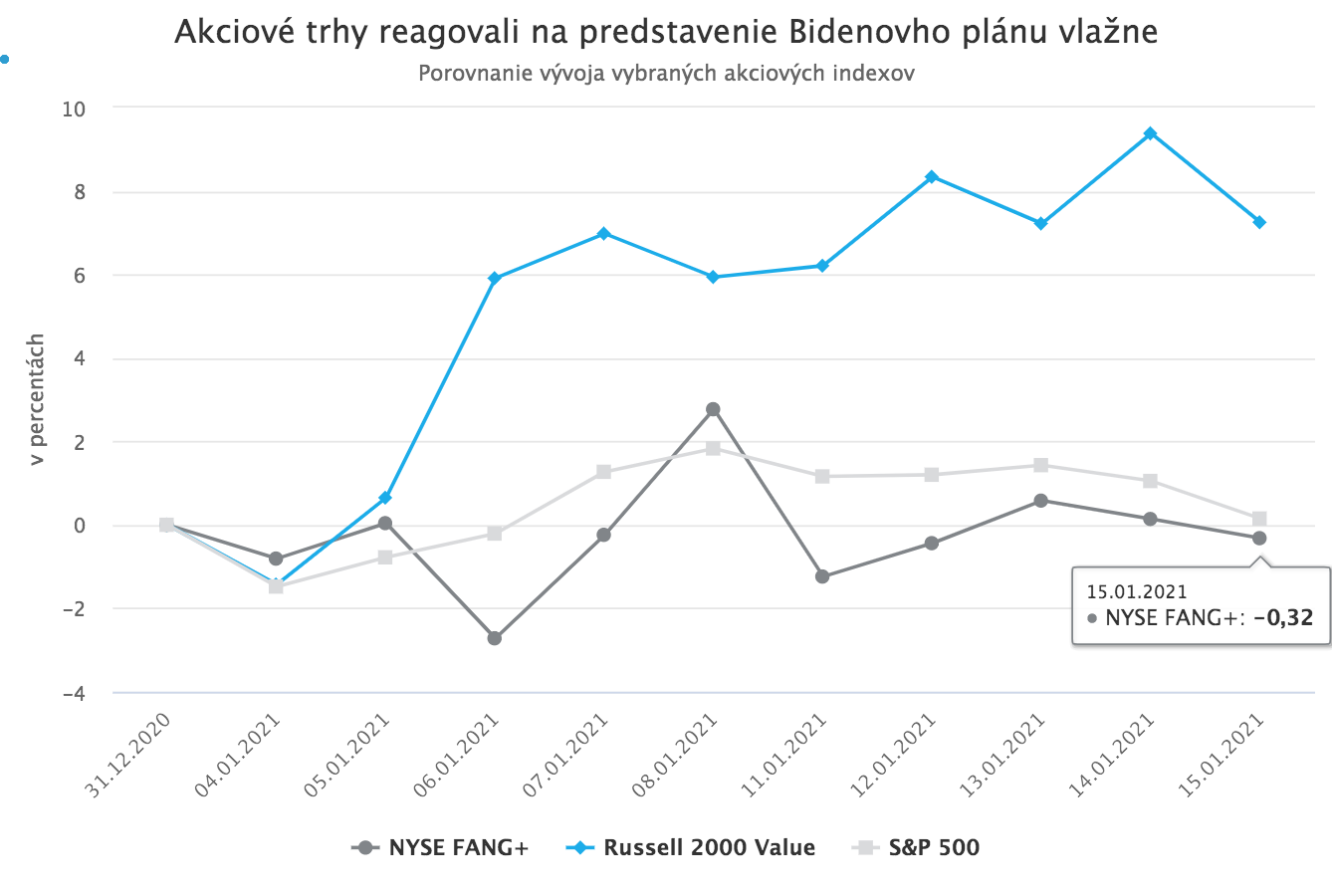
However, once investors became familiar with the details of Biden’s plan on Thursday evening, these moves came to a halt. Stocks of both small and large companies moved slightly lower. Bond yields fell at the same time and the dollar strengthened. These are clear signs that Biden’s plan fell short of investors’ overly optimistic expectations. The reason is likely concerns that Democrats may have difficulty passing the plan, since it also contains some proposals seen as too “radical.” These include, in particular, raising the minimum wage and providing support for states and local governments. Democrats do have a comfortable majority in the House of Representatives, but in the Senate only the narrowest one. Moreover, some Democratic senators are known for their opposition to higher government spending, so there is no 100% certainty that each of them will vote in favor. Biden would therefore benefit from support from at least some Republicans. But that is difficult, because the “radical” measures mentioned above will be unacceptable to Republicans. Approval of Biden’s plan in its current form is therefore not guaranteed, and it will likely be accompanied by a long political battle.