Environmental Crisis: An Economic Snapshot
Date created: 21 June 2023
The world advanced by leaps and bounds in recent decades — but the past has caught up with us. Today few dispute global warming, extreme weather swings or rising numbers of natural disasters. What are their economic effects, and can the speeding train still be stopped?
Natural disasters worldwide
In recent years natural disasters have been occurring more frequently and with greater intensity than before. Part of this is attributable to reckless human behaviour toward the environment, but many catastrophic events also occur independently of human action. Specific geographic zones remain repeatedly affected by floods, typhoons, tornadoes, earthquakes and other hazards.
These events are not isolated. Consider the 7.8magnitude earthquake that struck Turkey and Syria, killing more than 50,000 people and producing damages exceeding USD 100 billion. Or Hurricane Fiona in September 2022, which cut electricity and water to hundreds of thousands and caused major damage across Puerto Rico, the Dominican Republic and, as a tropical storm, parts of Canada.
To illustrate a storm’s destructive power: in Canada Fiona produced waves up to 15.9 metres high — roughly the height of a fourstorey building — and damages approached USD 4 billion.
Another catastrophic event occurred in Pakistan in late August–early September 2022, when monsoon rains effectively created a 100kmwide inland sea. Floods wiped entire villages off the map and caused more than 1,000 deaths, affecting an estimated 33 million people. Damages there reached historical highs, exceeding USD 40 billion. Pakistan is a large country by population (≈225 million) but is a developing economy with GDP around USD 350 billion, so international assistance from the UN and IMF was required to finance recovery.
How large are total losses?
Alarmingly large. Swiss Re estimates that insured and uninsured losses from natural catastrophes in 2022 reached about USD 275 billion. The average annual growth rate of recovery and disasterremoval costs has been roughly 5–7% in recent years and shows no sign of slowing.
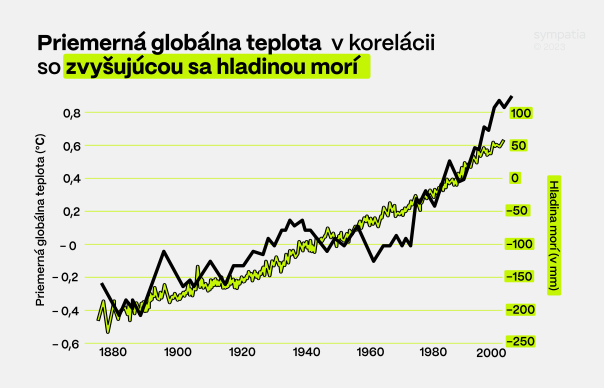
Extreme heat also had deadly consequences: European countries recorded more than 20,000 excess deaths during heatwaves. According to the U.S. National Centers for Environmental Information, 2022 was the secondwarmest year on record for Europe and the sixth globally; 2020 remains Europe’s warmest year. Global warming is evident, and denying it will not solve the problem.
What is the economic impact?
Swiss Re research suggests the global economy could lose up to USD 23 trillion by 2050 in a worstcase scenario — roughly an 18% contraction. Developing regions such as ASEAN and Africa would be the hardest hit (potential declines close to 30%), while advanced economies might see declines around 10%. This extreme scenario corresponds to an average global temperature rise of roughly 3.2°C.
If the Paris Agreement commitments were met and warming were limited to about 2°C, global GDP loss would be around 4.2%, with developing regions suffering at most about a 5.5% decline. The most likely pathway today projects warming of 2.0–2.6°C, which could reduce global economic output by about 11–13.9%.
Can anything be done?
Scientists and experts propose many mitigation and adaptation measures, but few can be implemented instantly or at zero cost; many require investments on the order of trillions of dollars. Key mitigation measures include scaling renewables and phasing out fossil fuels. Some effective steps cost little or nothing — reducing consumption and curbing waste wherever possible is immediately actionable.
Adaptation measures also matter: building flood defences (dams, levees), avoiding construction in highrisk zones, and stricter landuse planning can reduce impacts. Strict compliance with the Paris Agreement remains central to limiting future damage.
However, responsibility is uneven. Some developing countries are still expanding environmentally intensive production, while advanced economies effectively offshore environmental burdens by importing goods with high environmental footprints produced abroad. The net global footprint therefore persists even where domestic emissions fall.
Is Europe safe?
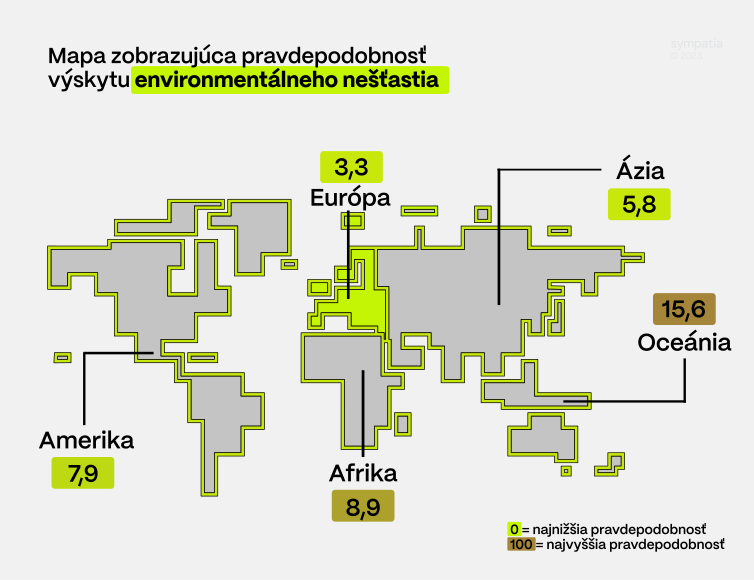
Generally, Europe ranks among the safest regions in terms of exposure to frequent natural disasters — an important consideration for business environments and realestate investment. Few investors want property in floodprone or regularly disasterhit areas.
How to avoid risk?
The best property investments are in locations with low climatehazard exposure. When choosing realestate investments, consider location, expected returns, and environmental and geopolitical risks. Most private investors lack the expertise to fully assess these factors; for many, investing through real estate funds or catastrophelinked bonds may be a more prudent approach.
Disclaimer
All texts, images, graphics and other objects in this document are protected by copyright and may not be copied, distributed, modified or provided to third parties without the prior written consent of Sympatia Financie, o.c.p., a.s. This document contains general information only. Sympatia Financie, o.c.p., a.s. does not provide professional advice or services through this document and is not liable for any damage arising directly or indirectly from reliance on its contents.