EU to increase investment in defense
Joint procurement of defense equipment and investment in European industry should also be strengthened to ensure diversification of suppliers. The defense sector responded to this news with gains in stock markets in Europe and the U.S. France, which currently holds the presidency of the Council of the EU, has long been a supporter of a common European army. In the current situation, this idea is more realistic and it would also address the issue of neutral countries in the Union. These countries are not members of NATO, so their defense largely rests on their own shoulders. Solving this puzzle would provide them with greater security and stability. Germany, which carries significant weight in the EU, could also take a supportive stance on this issue. After recent events, it might back such an initiative and thus strengthen the security of citizens.
EU countries will increase spending on armaments
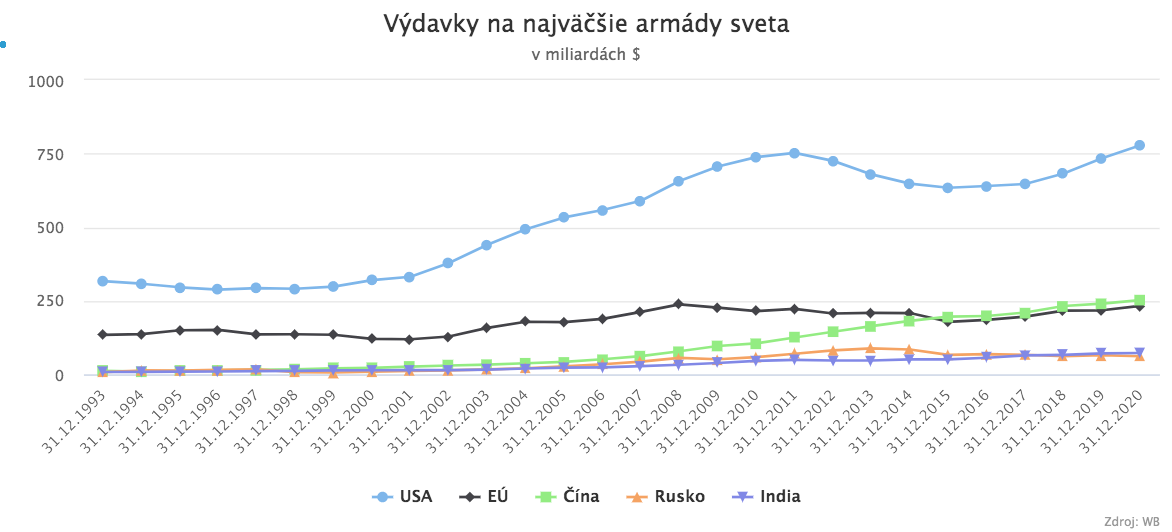
In recent years, the Union did not perceive geopolitical threats. Most countries relied on NATO membership and reduced their defense spending. In today’s situation, we can already see that this was a major mistake, and the EU must be able to defend itself in real terms if necessary. Almost all members have announced increases in their budgets to the minimum level of 2% of GDP required by NATO membership. Many countries, in fact the vast majority, did not meet this target at all, even though the U.S. issued many calls to respect the minimum spending level. EU states last met the required 2% for defense in 1993. After that, this level gradually declined until 2015, when it reached its historical low of 1.32% of GDP. The situation began to change during this period because the Russian Federation annexed Crimea and the Union also recognized the possible risks. Spending started to rise again, but it still did not reach the required level. In 2020, defense investment in the EU reached USD 232.8 billion, which was 1.56% of gross domestic product. If the member states met the commitment at least at the 2% level, spending would amount to approximately USD 300 billion. The U.S. is almost the only NATO member that invests 2% of GDP in defense and consistently exceeds this threshold. For comparison, the Russian Federation spent USD 61.7 billion on defense in 2020 (4.26% of GDP) and the U.S. USD 778.2 billion (3.74% of GDP). Of course, Russia allocates a higher share of spending to defense in percentage terms, but from a much smaller economy. The U.S., on the other hand, invests a smaller share of its GDP in the military, but in absolute terms it equals about two national budgets of the Russian Federation. Simply put, as long as EU countries remain members of the North Atlantic Alliance, they have a very strong ally in the U.S
How are the V4 countries doing?
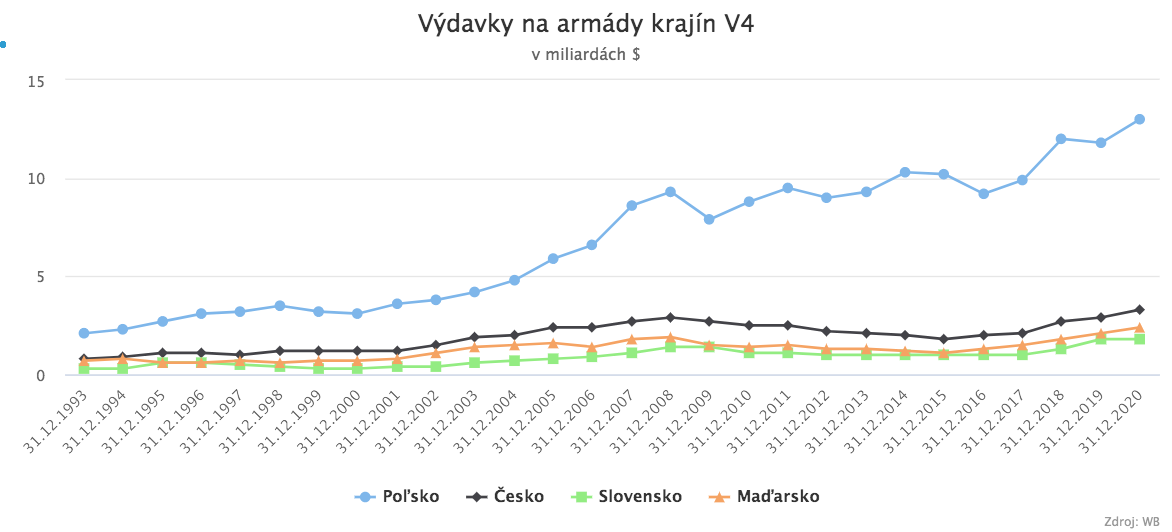
Poland invests the most in its defense among the V4 countries and has long maintained a range of 1.8% to 2.0% of GDP. Defense spending in Slovakia, the Czech Republic, and Hungary steadily declined after joining the EU. It reached its minimum in 2004, when it fell below one percent. Later, after tensions emerged in Eastern Europe in 2014, defense spending began to rise in these countries as well. However, it still did not reach the required 2% level; in 2020, the Czech Republic spent 1.3%, Slovakia 1.8%, and Hungary 1.6% on defense. In the current hectic situation, almost all states are announcing increases in spending to the 2% level, and in Poland’s case up to 3%. In addition, there is talk of possible financial support for Eastern EU countries so they can secure the necessary defense equipment.