Polaris Alpha Fund: An Alternative to European Assets
The fund’s primary objective is to ensure that realestate investments are managed professionally and without burden for the investor. The chart below shows Polaris Alpha outperforming European alternatives, which have lagged behind the fund’s performance and are, moreover, overly volatile — a factor that jeopardises investment returns. For example, the Euro Stoxx 50 equity index has not recovered from its peak to date. An investor who put money into that index at that time would still be down by more than 30% today — and more than 12 years have passed. The Prague PX index shows a very similar picture, losing roughly 30% from its peak with almost 15 years elapsed since its high.
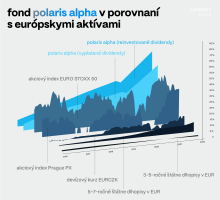
Government bonds, by contrast, display low volatility but have not delivered attractive returns over the period in question. European government bonds actually produced a loss over the comparative period. Czech government bonds achieved only a modest return, roughly equivalent to Polaris Alpha’s annualised yield. Interbank rates in euros yielded negative returns, while the Czech koruna produced a very small gain only at the end of the observation window. From a longterm perspective, such investments are of limited appeal and investors must search for better alternatives. Even investing in the EUR/CZK currency pair made little sense relative to our fund’s performance. Polaris Alpha has been able to deliver relatively high returns for its investors even during periods of low interest rates.
Compound interest
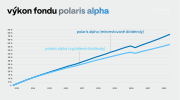
Compound interest is most commonly discussed in the context of passive investing via ETFs, colloquially index funds. Investors can observe the difference between the performance of accumulation funds (where dividends are reinvested) and distributing funds (where dividends are paid out). Here lies a key advantage of not paying out dividends: when returns are retained in the fund and reinvested, a client’s holding grows continuously and benefits from compounding. Over the long term this produces materially higher returns. For illustration, if an investor had reinvested dividends over the comparison period, they would have achieved roughly 15% higher returns (50.22% without dividend reinvestment versus 64.54% with reinvestment).
Volatility
Volatility, i.e. the fluctuation in an asset’s value, is an important indicator for investors. It shapes an investor’s perception of the investment’s risk over particular timeframes. The higher this indicator, the wider the potential price swings. Volatility is particularly relevant for conservative investments because with low volatility the client can be confident that their invested funds will be accessible when needed and with minimal risk of withdrawing at a loss. Such comfort is not offered by equity indices, which regularly experience large swings. Looking at the compared assets, we see either significant volatility or almost no return.
Sharpe ratio
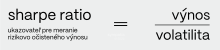
The Sharpe ratio measures an investment’s risk relative to its return, incorporating past performance, volatility and, theoretically, the riskfree rate. As a general rule, a Sharpe ratio above 1 indicates a suitable riskreturn profile. Conversely, an analysed asset with a Sharpe ratio below 1 does not present an appropriate riskreturn tradeoff. Among the compared assets Polaris Alpha clearly dominates, with an average Sharpe ratio of 12.82, while the Prague PX stands at 0.18 and the Euro Stoxx 50 at only 0.11.
Annual performance
Many investors continually attempt to time the market and catch the bottom. Our fund, however, owing to negligible volatility, does not exert such timing pressure on investors. Polaris Alpha has never recorded a negative 12month average return across its entire history. A potential client therefore does not need to time their investment at all — speculating on a market fall would bring no benefit. The maximum temporary drawdown of Polaris Alpha was only 1.34%, compared with more than 61% for the Euro Stoxx 50 and almost 67% for the Prague PX. In recent years the domestic market has also seen the rise of “maximum return” funds that select equities globally but suffer significant volatility (maximum drawdown 36.77% p.a.).
Technology stocks under pressure
In recent weeks and months, the largest falls on the equity markets have occurred predominantly among technology stocks. Several reasons explain this. First, tech stocks were generally overvalued. Second, central banks have been raising interest rates, which places particular pressure on technology companies that typically generate little cash and will face higher financing costs. Third, in turbulent times investors tend to flee to more conservative assets, so tech stocks are being sold off. Fourth, tech equities suffer markedly higher volatility than other sectors.
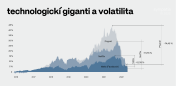
Notable recent collapses include Netflix, which has lost more than 70% from its peak — returning its share price to 2017 levels; investors who did not sell at the highs have therefore made no gain over the period. PayPal similarly has shed roughly 70% from its peak. Meta (Facebook) is also down around 50% from its highs. The Nasdaq index (composed largely of technology companies) has lost nearly 26% from its peak. These examples illustrate how market timing is frequently difficult and even the most prominent names can disappoint investors. In the best case an investor loses only unrealised gains; in the worst case they suffer significant realised losses. The investor is left either to wait years for recovery or to realise the loss. Investing in individual equities is therefore extremely challenging and for most investors appears unsuitable.
For more information about the fund click here or contact us directly at polaris.alpha@sympatia.sk.
Disclaimer: all texts, images, graphics and other objects placed in this document are protected by copyright and may not be copied, distributed, altered or provided to third parties without the prior written consent of Sympatia Financie, o.c.p., a.s. This document contains general information only. Sympatia Financie, o.c.p., a.s. does not provide any professional advice or services through this document and accepts no liability for any damage arising directly or indirectly in connection with any person relying on this document.