The Global Economy Is Starting to Recover

Surprisingly strong U.S. labor market data released last Friday sparked a wave of optimism that economies could emerge from the coronavirus shock faster than initially expected. The report showed that the United States added 2.5 million jobs in May, pushing the unemployment rate down from 14.7% in April to 13.3%. Analysts had expected a loss of 7.7 million jobs, and rather than a decline in unemployment, had been bracing for a sharp increase toward 20%. The outcome was therefore a major surprise.
The shock was so large that investors immediately looked for confirmation elsewhere, notably in Canadian labor market figures, to gauge whether the U.S. data reflected a genuine turning point rather than statistical “creativity” from the Trump administration. Canada’s numbers pointed in the same direction, helping convince even skeptical investors that the U.S. recovery may already be under way. President Trump, as one would expect, spent much of Friday and the weekend celebrating what he called “record” labor market figures, arguing that they proved he had “built the greatest economy in the world, the best economy the United States has ever had.”
A record recovery in employment?
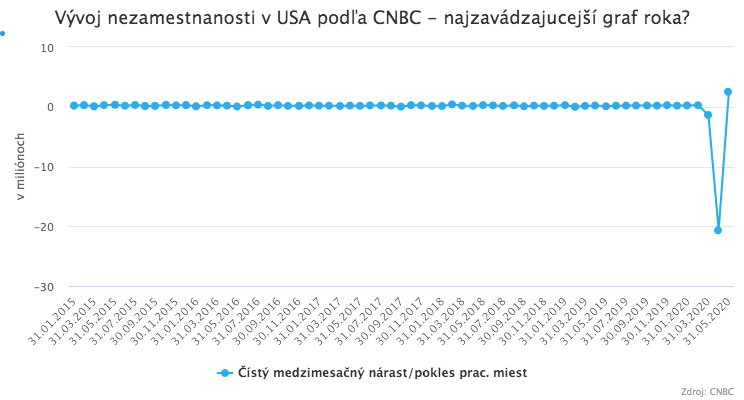
The figures are indeed record-breaking (the largest net month-on-month increase in employment in the history of U.S. statistics) and can be taken as evidence that the U.S. economy has begun to recover. Beyond that, however, interpretation depends on perspective.
Plotted the way CNBC did (a chart also retweeted by Trump), the data look spectacular and invite optimism. Yet this chart is a strong contender for the most misleading graph of the year. Plotting net month-on-month job changes in isolation is not particularly informative, because each month does not begin from zero. Jobs created remain in place and jobs lost do not automatically return. A far more meaningful approach is to look at the change cumulatively.
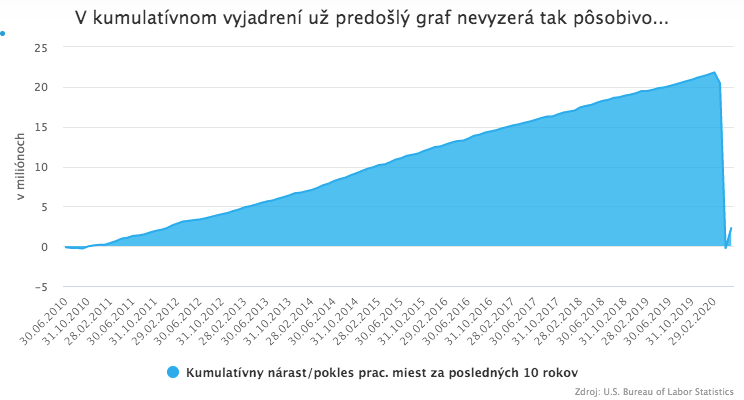
Viewed that way, it becomes clear that May’s “record” rebound is less reason for celebration, because it followed an even more extraordinary collapse. The massive decline in employment in April effectively erased an entire decade of job creation. In a single month, more jobs were lost than had been created over the previous ten years. May’s gain therefore represents only a modest correction of that loss. Even if every subsequent month were as strong as May, it would still take a long time for the labor market to return to its pre-crisis state.
The Federal Reserve’s latest projections suggest that unemployment will not return to pre-crisis levels even over the next three years. The Fed expects the jobless rate to fall from the current 13.3% to 9.3% by the end of this year, to 6.5% next year, and to 5.5% in 2022. Still, the direction of travel is improving. And similar, often relative, improvement is now visible across a broad set of indicators across sectors and countries. It increasingly appears that the global economy has already passed the worst of the shock.
Manufacturing and services are showing early signs of recovery
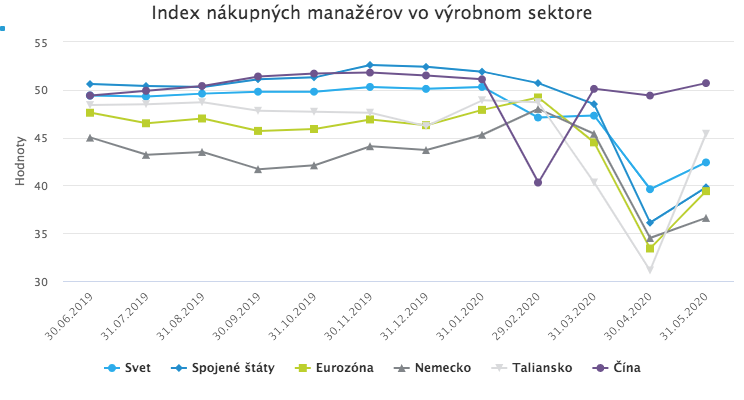
The trajectory of the Purchasing Managers’ Index (PMI), one of the most closely watched leading indicators, also points to a nascent recovery in the world’s major economies. PMI readings are derived from monthly surveys of private-sector managers and provide a timely snapshot of both current conditions and expectations, particularly in manufacturing and services. The index is constructed such that readings above 50 indicate expansion, while readings below 50 signal contraction.
As the chart below shows, manufacturing activity in the world’s major economies has begun to recover. China experienced its decline and rebound roughly two months earlier than other economies due to the earlier timeline of the epidemic. However, China’s data are often treated with caution, particularly during a crisis, which raised questions about whether other economies would follow a similarly rapid path. The May PMI data for the United States and Europe, however, also point clearly to improving manufacturing conditions, albeit at a slower pace than in China.
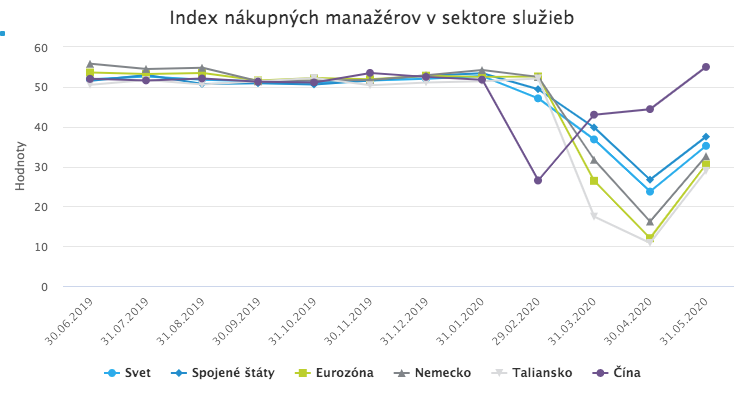
The services sector was hit even harder than manufacturing. Yet here, too, services PMIs show a stabilization and early recovery trend across the largest economies.
Alternative high-frequency data also point upward
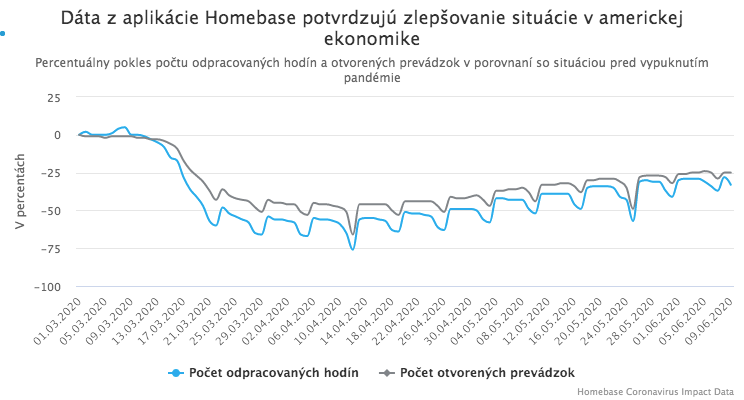
Beyond traditional leading indicators, a range of non-traditional, high-frequency datasets provides an increasingly granular, near real-time view of economic and social activity. One such source is Homebase, an app used by more than 600,000 small businesses in the United States to track employee attendance, payroll, and HR processes. Homebase data can be used to monitor, day by day, the number of hours worked and the share of businesses that remain open, making it a timely proxy for small-business employment and activity.
These figures show the same pattern as traditional indicators: a trough in April followed by a gradual rebound through May and June. They also support the view that an early labour market recovery is genuinely under way in the U.S., consistent with the official data cited above.
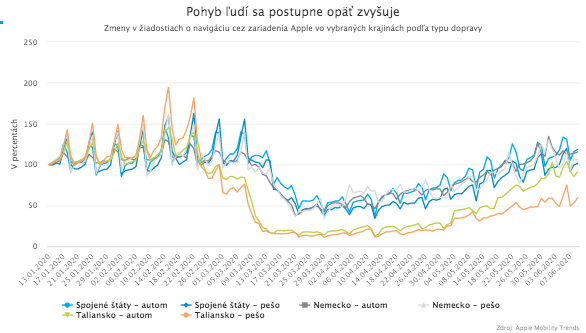
Economic activity, particularly in services, is closely linked to mobility. Apple mobility data show that movement has been rising steadily over the past two months and in some countries is already close to pre-crisis levels.
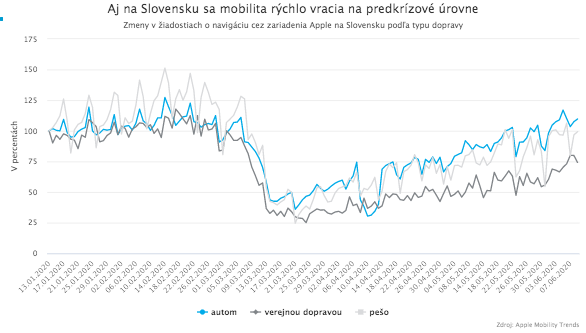
Mobility in Slovakia is also gradually increasing and may soon return to pre-crisis levels.
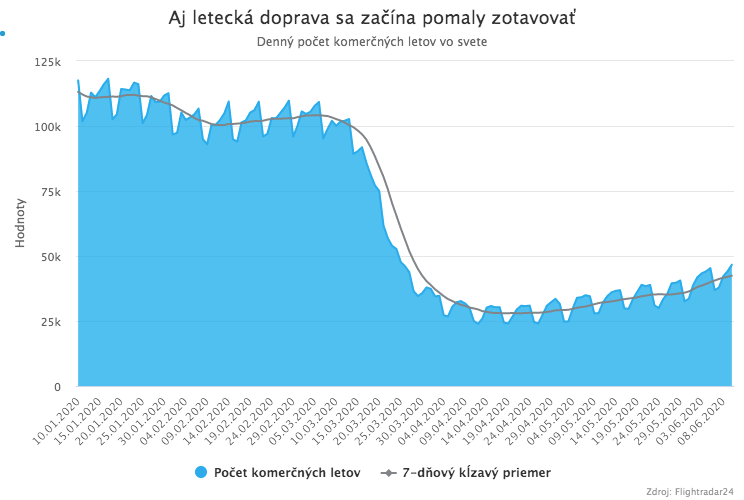
Air travel is beginning to recover as well, but only very slowly, reflecting ongoing cross-border restrictions. Aviation is also one of the sectors most likely to be structurally affected by the crisis, and a return to pre-pandemic levels could take a long time.
Cautious optimism remains warranted
The emergence of a recovery is encouraging. More important, however, is that it continues uninterrupted. Even under a favorable scenario, the path back will be long. In its latest report, the OECD estimates that even if the world avoids a second wave, the global economy will not return to pre-crisis levels for at least another two years. For the hardest-hit sectors, a full return to “normal” may not happen at all. As the OECD put it: “The crisis will leave long-lasting scars, including lower living standards, high unemployment, and weak investment.”