Saudi Aramco: The Oil Giant You Rarely Read About

Date: 20 March 2023
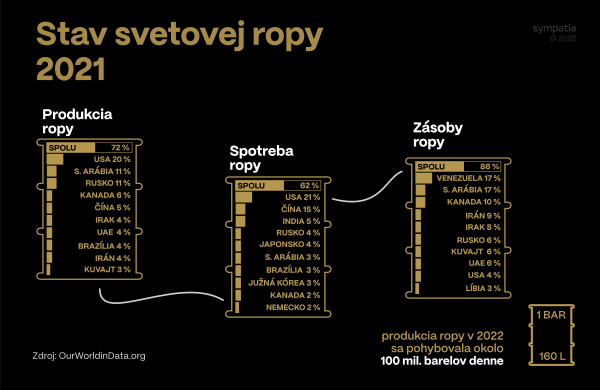
Saudi Aramco is the world’s largest energy company and the secondlargest publicly traded company by production, extracting more crude oil than almost any other single firm—econd only to the United States in total oil production. It is the dominant player in the Middle Eastern oil industry. Yet mainstream economic commentary often overlooks this giant, preferring to focus on market favourites such as Apple, Amazon, Google or Tesla.
Origins of Saudi Aramco
Saudi Aramco’s origins date to 1933, when the Kingdom of Saudi Arabia signed an agreement with the American Standard Oil Company of California. The joint enterprise immediately began exploration; the first exploratory wells were drilled in 1935. Commercially viable reserves were discovered five years after the contract (1938), and the first tanker departed the country the following year (1939).
Production and discoveries continued to rise, culminating in the construction of the Trans-Arabian Pipeline in 1950, a 1,212 km conduit that linked Saudi oilfields to the Mediterranean and accelerated deliveries to Europe. Shortly thereafter the company discovered the world’s largest offshore oil field, and by 1958 Aramco’s output had reached the symbolic milestone of 1 million barrels per day—an amount negligible by today’s standards given modern technologies and capacity.
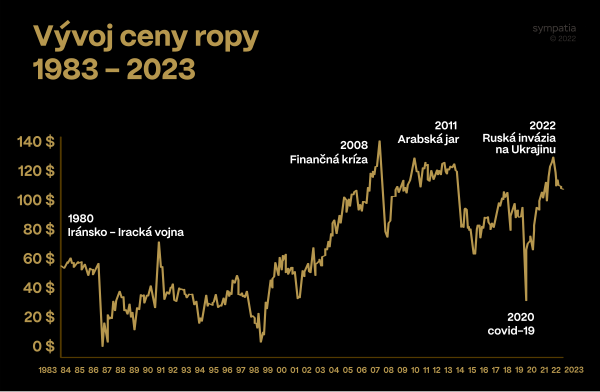
Growth accelerated further: by 1962 cumulative production reached 5 billion barrels, and by 1971 annual output hit 1 billion barrels. In response to growing national interest in its hydrocarbons, the Saudi government purchased a 25% stake in 1973 and increased that stake to 60% a year later. By 1980 Saudi Arabia moved to full ownership, acquiring 100% control of the enterprise.
Strategically, Aramco’s leadership recognized that reliance on crude extraction and export alone could be enhanced: higher value added and greater margins were essential. In 1989 the company formed a joint venture with Texaco in the United States; that partnership later ended with Aramco assuming full control. In 2017 Aramco became owner of the largest crude refinery in North America. The United States has maintained strategically important relations with the Kingdom, and U.S. presidents have periodically engaged Saudi leadership when crude supply tightness has pressured global markets.
Although U.S. oil companies played a formative role in Aramco’s creation and modernization, Saudi Aramco is now wholly Saudiowned and ranks among the most technologically advanced and wealthiest energy firms in the world—active not only in upstream oil and gas production but also in refining and downstream products. The Kingdom’s hydrocarbon wealth has made it a consequential international actor, since oil and gas remain vital global commodities.
How Saudi Arabia manages its cash surplus Like other hydrocarbon exporters?
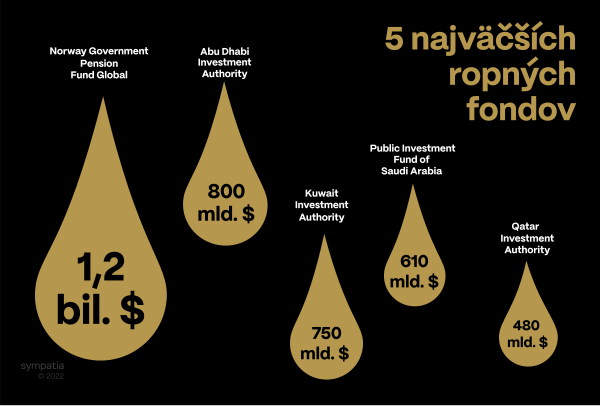
Saudi Arabia invests petroleum revenues for future generations via sovereign wealth funds. Saudi Arabia’s sovereign wealth assets are currently estimated at roughly USD 610 billion. For comparison, Norway’s Government Pension Fund Global manages about USD 1.2 trillion despite significantly smaller reserves, Qatar’s sovereign wealth fund manages roughly USD 480 billion, and the UAE’s funds are on the order of USD 800 billion.
Saudi Aramco shares
A milestone for the company was its initial public offering in 2019. Aramco listed approximately 1.5% of its equity, raising about USD 25.6 billion despite a 2018 net income of approximately USD 111 billion. The limited float indicates the IPO’s limited capital-raising objective: the offering served more as a valuation and partial transparency exercise than a capitalraising necessity for the stateowned behemoth. In recent years Aramco has also issued tens of billions of dollars in bonds.
Aramco’s influence Saudi Aramco’s position is highly significant both domestically and across global oil markets, including within OPEC. The company controls an estimated 337.33 billion barrels of crude oil reserves—effectively the Kingdom’s known reserves—and operates 11 oil and 5 gas fields. Saudi Arabia holds the world’s secondlargest proved oil reserves, accounting for roughly 17% of global reserves; for this reason, the country and Aramco remain central and influential partners in energy diplomacy and market stability.
Major competitors
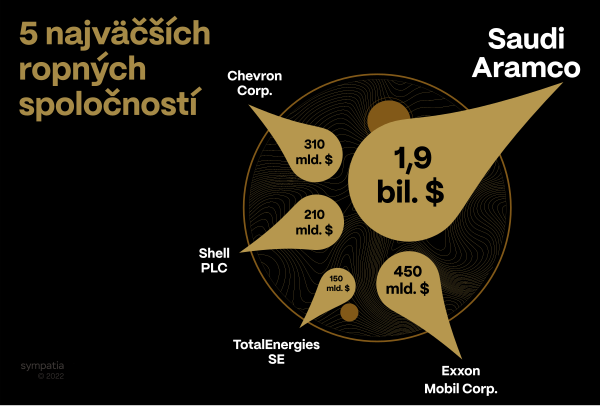
Aramco is not the only heavyweight in the global energy sector. Major international peers include Royal Dutch Shell, BP, Exxon Mobil, TotalEnergies, Chevron, Sinopec and PetroChina. The difference is that these firms typically combine large downstream operations with smaller insitu reserves than Saudi Aramco; despite often having larger revenues, their net profitability can approach Aramco’s because Aramco benefits from exceptionally low upstream costs and vast reserves. Aramco’s dominant domestic position—effectively the single large upstream operator in Saudi Arabia—confers competitive advantages that are rare in markets where multiple firms compete across exploration, production and refining.
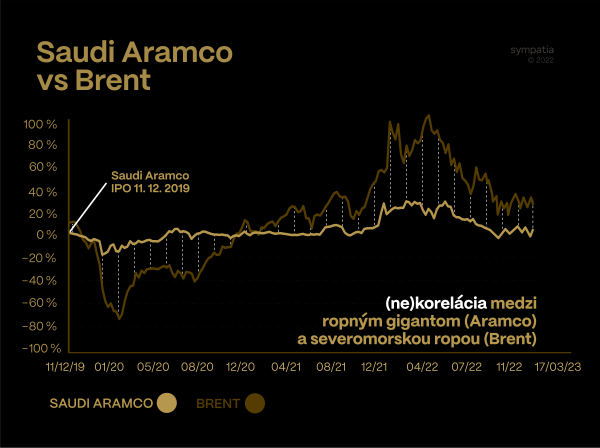
Resource constraints and geopolitical behaviour It is important to remember that hydrocarbon resources are finite and that production and pricing decisions have global consequences. Recent geopolitical behaviour—such as Russia’s sometimes destructive handling of gas supplies to Europe—illustrates how states may prioritize political objectives over export revenue, with knockon effects for global energy markets.
Disclaimer
All texts, images, graphics and other objects in this document are protected by copyright. Without prior written consent from Sympatia Financie, o.c.p., a.s., the content of this document may not be copied, distributed, modified or provided to third parties. This document contains general information only. Sympatia Financie, o.c.p., a.s. does not provide professional advice or services through this document and is not liable for any damage arising directly or indirectly from reliance on it.