Tensions Between the U.S. and China Are Escalating: Is a Trade War 2.0 on the Horizon?
U.S. equities have rebounded rapidly from the sharp, pandemic-driven sell-off. The S&P 500, the key U.S. benchmark, is now only about 15% below the highs reached just before the outbreak of Covid-19. At the trough of the March liquidation, the index had fallen as much as 34% from those levels.
The speed of the recovery has been driven primarily by massive monetary stimulus from the Federal Reserve, as well as the sharp rally in the five largest U.S. technology companies. These firms have been far less affected by the crisis than businesses in traditional sectors. Given their enormous market capitalization, they carry substantial weight in market-cap weighted indices such as the S&P 500 (now more than 21%), thereby pulling overall index performance higher and masking weakness elsewhere. Largely on the back of these forces, U.S. equities delivered their strongest monthly gain since 1987 in April, even as the economy was simultaneously producing some of the worst data in modern history. The S&P 500 rose by almost 13% in April.
Few expected such a powerful bounce from the March lows. Even now, surveys of clients at major investment banks suggest that most investors remain reluctant to add exposure at these levels, preferring to wait for another pullback.
Those concerns are not unfounded. Many fear that the rally of recent weeks rests on fragile foundations and that a renewed decline in equities is only a matter of time (even if a decisive break below the March lows no longer looks likely). The single factor with the greatest potential to reprice risk assets lower is the threat of a renewed trade conflict between the United States and China.
In recent days, relations between the two countries have visibly deteriorated and rhetoric has intensified. President Trump and U.S. Secretary of State Mike Pompeo have publicly argued that the coronavirus did not spill over to humans at a Wuhan wildlife market, as initially assumed, but instead accidentally leaked from a local laboratory. They have also accused China of bearing responsibility for the global spread of the virus, arguing that Chinese authorities concealed the situation in its early stages.
China, unsurprisingly, has responded in kind. While Chinese state media, as usual, have largely avoided direct attacks on Trump himself, they have dispensed with restraint when it comes to Pompeo, describing him as a “malicious clown spewing poison.” Beijing rejects responsibility for the pandemic and argues that U.S. officials are seeking to deflect attention from their own mistakes by shifting blame to China.
The risk, however, is that this confrontation does not remain confined to words. On the contrary, the probability is rising that it translates into concrete policy action. The Trump administration is reportedly weighing a range of options to impose economic costs on China for the damage caused by the pandemic, from relatively mild measures to extreme (and, importantly, unlikely) proposals.
One of the most moderate, and at the same time among the most plausible, steps under consideration would be to bar the federal employees’ retirement plan (the Thrift Savings Plan) from investing in Chinese equities. A similar move was already discussed last year at the height of the previous trade war. Another option being debated is the imposition of targeted tariffs or sanctions, potentially coupled with a withdrawal from the Phase One trade agreement.
More extreme and unlikely ideas that have nevertheless surfaced within the administration include freezing Chinese assets in the United States or even refusing to repay U.S. Treasury securities held by China. These proposals are highly improbable, not least because they are technically difficult to implement. Were Washington to pursue them, many experts argue that such a step would amount to an act of war. It is therefore unlikely that either side would want escalation to go that far, regardless of the increasingly hostile rhetoric.
Still, even a relatively limited form of “economic punishment” would carry meaningful consequences, not least by opening the door to further escalation. For example, a ban on pension-fund investment in Chinese equities could plausibly trigger Beijing to walk away from the trade agreement, reigniting a cycle of tariffs and retaliatory tariffs, with negative spillovers for global growth, international trade, and financial markets.
A trade war is, quite simply, the last thing fragile economies grappling with the pandemic need. It would undermine any hope of a swift post-pandemic rebound. Yet a renewed flare-up now appears increasingly difficult to avoid.
We do not attempt to judge the true origin of Covid-19 or the degree of responsibility China bears for the outbreak. What does seem highly likely, however, is that with U.S. presidential elections approaching, an economy battered by the coronavirus, and a chronic unwillingness to accept responsibility for domestic failures, Trump’s campaign will focus heavily on blaming China and promising tough retaliation. The key questions are whether these promises translate into policy and how China responds.
Investors are already watching a familiar barometer: the daily fixing of the Chinese yuan against the U.S. dollar.
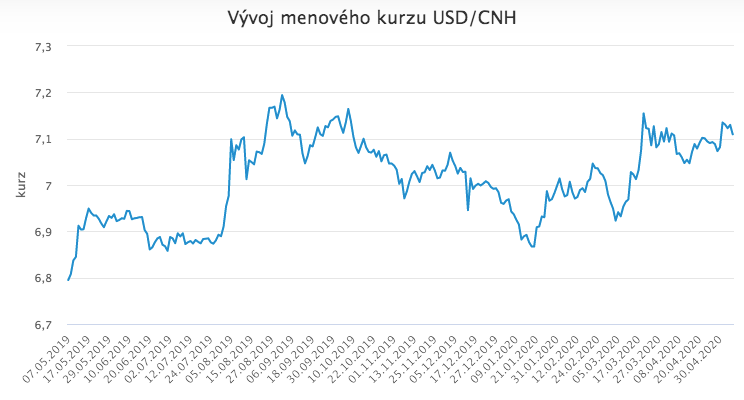
The yuan-dollar exchange rate is a relatively precise gauge of tensions in U.S.-China relations. Each day, the People’s Bank of China sets the yuan’s reference midpoint against the dollar. The United States has long pressed China not to weaken the yuan, arguing that a softer currency unfairly advantages Chinese exporters selling into the U.S. market. Any meaningful yuan depreciation is therefore often interpreted as a warning signal from Beijing that it is prepared to escalate beyond rhetoric into economic measures.
Last summer, the fixing moving beyond the symbolic threshold of 7 USD/CNH triggered a sharp market sell-off.