What impact will automation and robotization have on the world?

How is Slovakia doing?
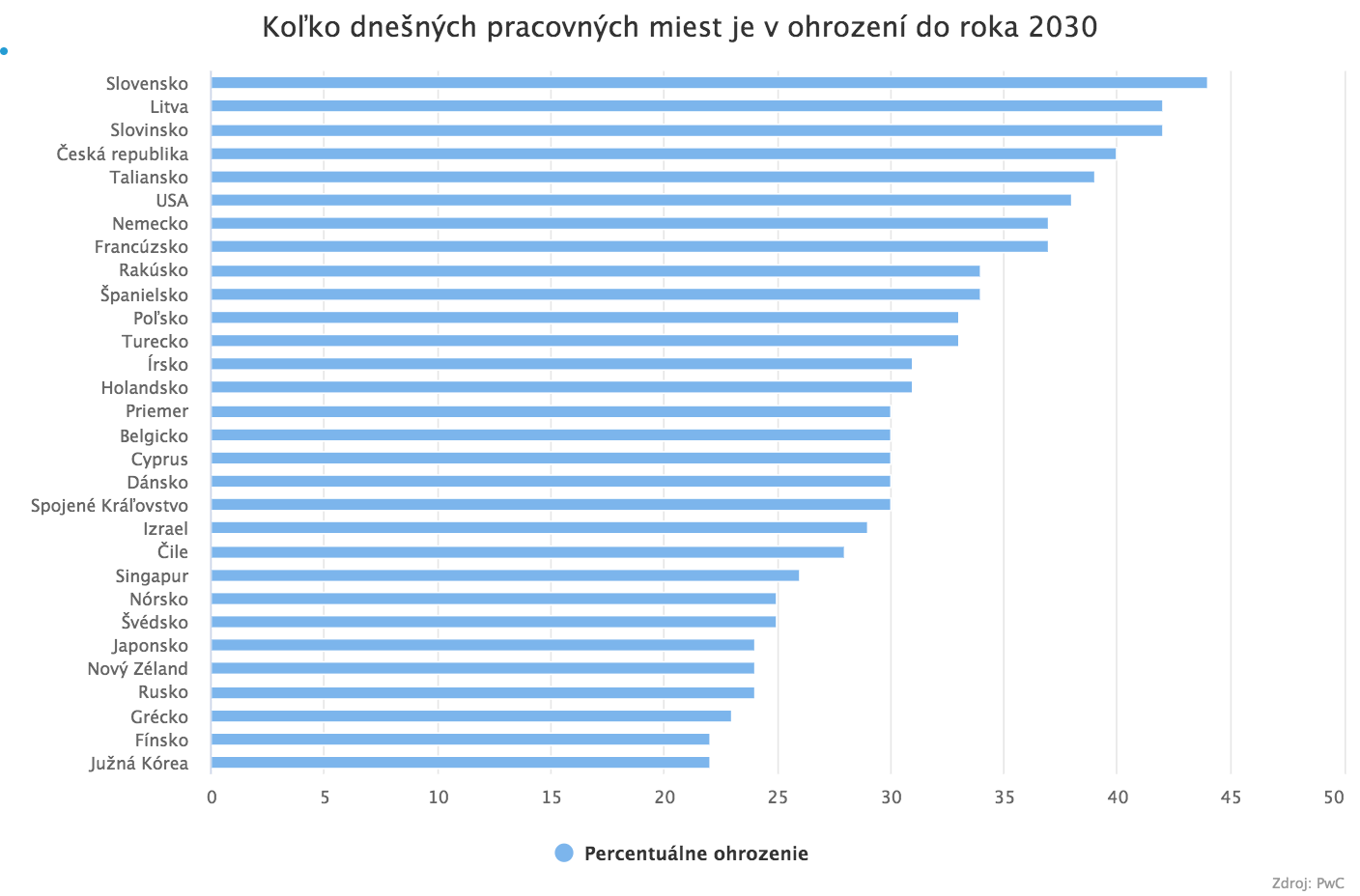
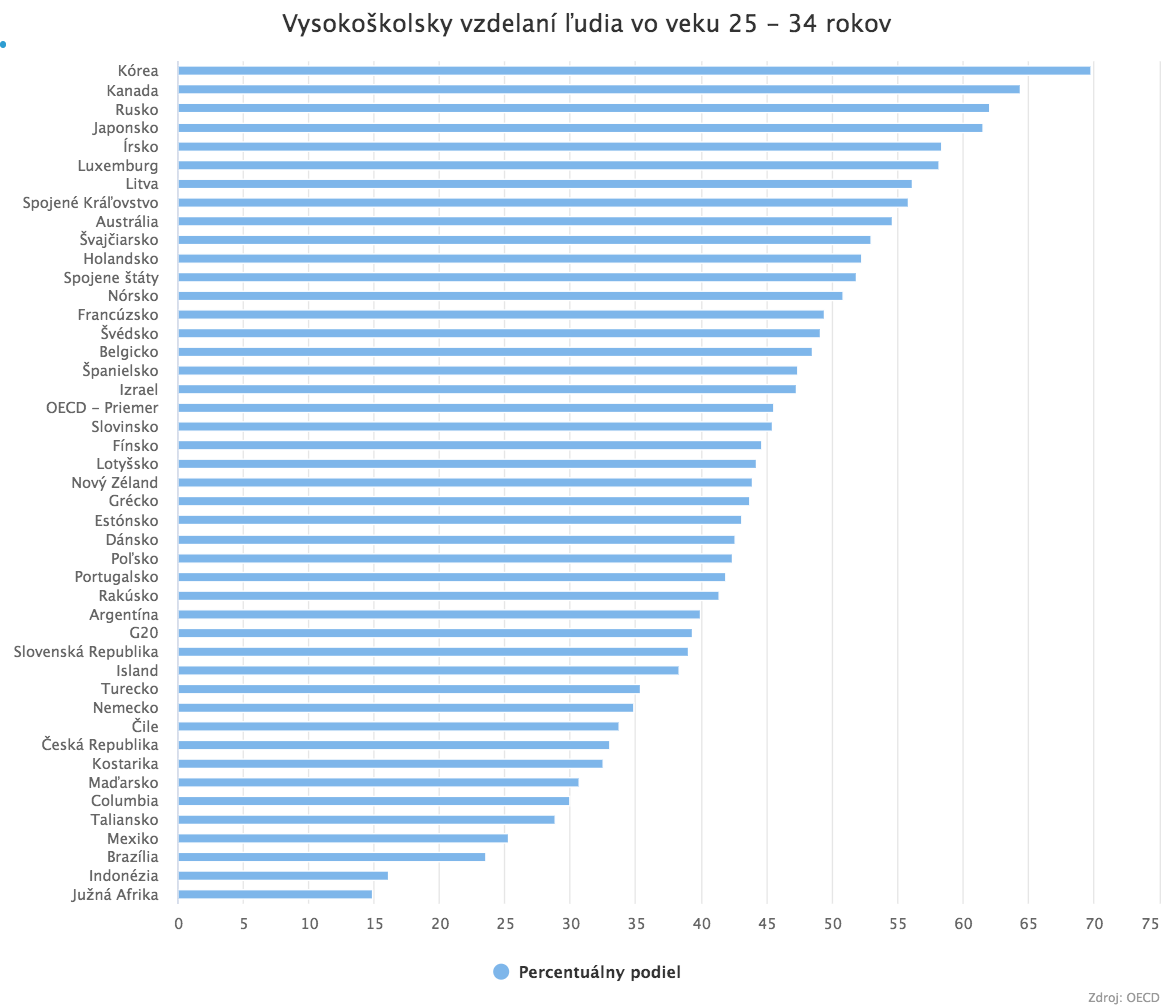
Slovakia has once again ranked among the worst, and according to analysts’ estimates, about 44% of jobs are at risk in the country. Interestingly, men are more exposed to job losses than women. Men face a job-loss risk of 48%, while for women it is “only” 39%. This is probably because men more often perform manual work in factories. It is also noteworthy that the share of women with a university degree in the 25 to 34 age group in Slovakia exceeds 49%, whereas for men in the same age group it is about 29%. This is precisely the generation group that will be most affected by the upcoming changes in the labor market. A positive fact remains that only 18% of positions filled by university-educated people will be exposed to the risk of disappearing. In contrast, jobs suitable for people with secondary education are at risk at 53%, and for those with only primary education as high as 54%. If we look at the average in the 25 to 34 age group, we have a higher share of university-educated people than Germans, Czechs, Hungarians, or Italians. Despite this, Slovakia needs to focus more strongly on education if we want to catch up with the best. A major problem for Slovakia is also the long-term brain drain. This issue was examined by the Institute for Public Affairs in cooperation with the ESET Foundation. The result is alarming, as as many as 50% of university students and graduates plan to leave Slovakia. Fortunately, not everyone plans to stay abroad permanently. Fourteen percent are considering a permanent departure, and 36% are considering working abroad temporarily. According to the survey, the strongest motivation for leaving abroad is the socio-political dimension. In Slovakia, the education segment is the most resilient to incoming technological changes. This sector shows high resilience, and it is estimated that the share of endangered positions in education is 14%. The most threatened sector in Slovakia is manufacturing, at 58%. The problem remains that Slovakia has a relatively large allocation of both labor and economic power in this sector. However, even here it holds that positions requiring lower qualifications are significantly more at risk than those requiring a university degree. It is also important to note that the SARS-CoV-2 pandemic significantly accelerated technological processes in both digital and real life. As a result, innovations are already capable today of replacing up to 25% of jobs in Slovakia.
What will the global impacts be?
For North America, last year was record-breaking, as companies managed to deploy more than 40,000 new robots. However, this figure was not achieved at the expense of higher unemployment; on the contrary, the United States managed to reduce unemployment throughout the entire year. A similar trend of deploying robots in companies can be seen worldwide, and we should expect it to continue. It will advance mainly where the manufacturing sector makes up a significant share of a country’s economy. The global economy currently has a GDP of approximately USD 85 trillion. Thanks to automation and robotization alone, this figure is expected to increase by USD 15 trillion by 2030. We will owe this primarily to a significant increase in labor productivity, which will not suffer from as high an error rate as is the case with humans. In order for people to be able to compete with technology, they must get used to more frequent reskilling. Continuous upgrading of knowledge and more frequent job changes will be common practice in the future. All economically active people must prepare for these changes and adapt to them in their own interest. Even today, under the provisions of the Labor Code, every employee is required to continuously deepen their qualifications for the work agreed in the employment contract. Historically, the world has gone through industrial revolutions many times. The difference is that today the changes will come much faster than in the past. Up to one billion jobs as we know them today may be at risk, so we need to prepare for the coming transformation.
Are we facing a wave of unemployment?
Certainly not. The world has gone through many waves of innovation, and work has never disappeared so far. Quite the opposite. However, it remains true that with each change, mainly more qualified work with higher added value emerges. All transformations shared a common feature: reducing monotonous and boring work. People often resisted these changes, but in the end it turned out that they always brought a higher standard of living to the world.