Croatia: An Economy with Enormous Potential
Despite its considerable potential, Croatia’s economy underperformed expectations for a long time, even after joining the European Union in 2013. Convergence was slow, held back by structural weaknesses and political constraints. In recent years, however, the picture has gradually improved, supported by reforms, more favorable political dynamics, and deeper integration into European institutions. Today, Croatia is finally in a position where it has the prerequisites to unlock its strong potential and shift into a higher-growth trajectory. Paradoxically, the pandemic has also played a role in that progress.
Rising resilience
The immediate impact of the Covid-19 shock on Croatia was, unsurprisingly, negative, but the crisis also highlighted the economy’s increasing resilience. GDP contracted by around 8% last year, largely reflecting the country’s heavy dependence on tourism, which accounts for close to 20% of economic output. Yet countries with similarly large tourism sectors typically suffered even deeper declines.
One advantage Croatia had was a strengthening manufacturing and construction base, which was only moderately affected by the pandemic. The social and economic fallout was also cushioned by generous government support for affected households and businesses. Unlike during the 2009 crisis, the government was able to deploy large-scale support thanks to markedly improved fiscal discipline, motivated in part by its ambition to adopt the euro. In the three years before the pandemic, Croatia ran budget surpluses.
Croatian tourism also proved more resilient than many had expected, particularly relative to non-European destinations. Unlike popular Asian holiday locations, Croatia benefited from its proximity to key European markets and from relatively high vaccination rates. As the epidemiological situation in Europe improved, the tourism sector rebounded quickly. The number of tourists visiting Croatia rose 59% year on year in August, reaching almost 90% of the level seen in August 2019. Tourism revenues during the peak season have already exceeded pre-pandemic levels, hitting a new record.
A strong recovery
These factors helped Croatia rebound quickly from the pandemic recession. This year it has ranked among the fastest-growing economies in the European Union. In the second quarter, GDP grew by a record 16.1% year on year, driven not only by base effects but also by a broad-based rise in activity across most sectors.
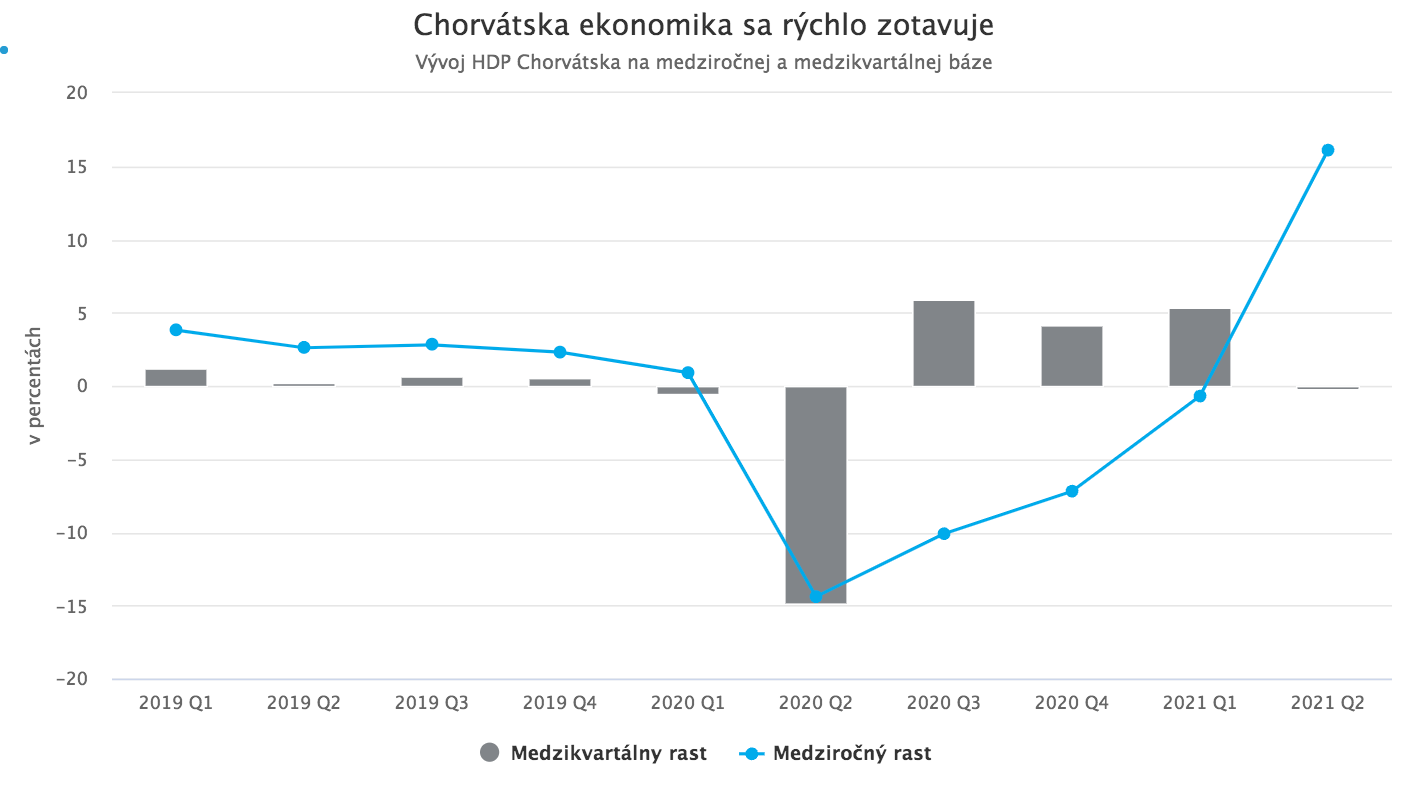
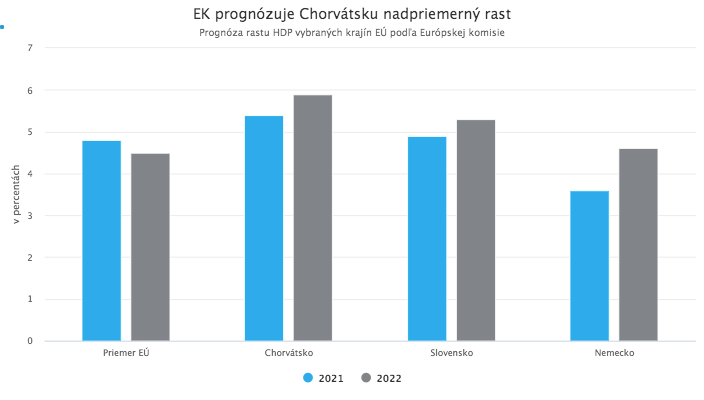
According to the European Commission’s forecast, Croatia’s GDP growth should reach 5.4% this year. The Ministry of Finance is more optimistic; citing a faster-than-expected tourism recovery, its updated August projection puts growth at 7%. International institutions also expect Croatia to remain among the EU’s stronger performers over the next two years.
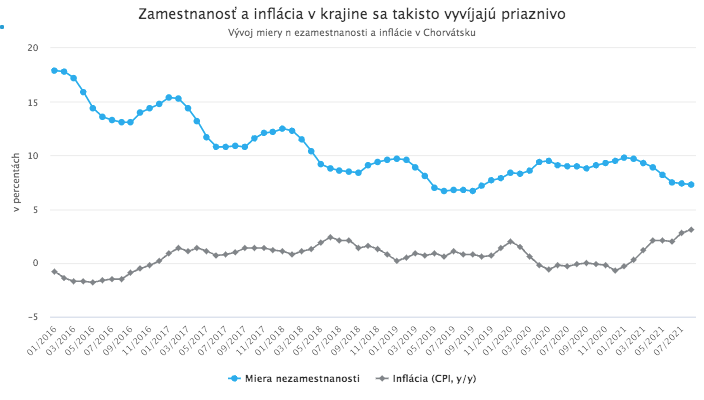
Other macro indicators are also moving in the right direction. Inflation, as elsewhere in Europe, has risen in recent weeks, but is expected to stabilize and fall back below 2%. Unemployment dropped back to pre-pandemic levels as early as June, and is expected to remain below 9% in the coming years. Demand for labor has hit record highs for four consecutive months.
As with all near-term economic forecasts, the outlook is highly uncertain, driven by the unpredictable path of the pandemic. Any sharp deterioration in Europe would again weigh on Croatia and could produce an outcome materially weaker than current projections imply. At the same time, Croatia has a meaningful chance to outperform expectations in the coming years and accelerate convergence toward EU income levels. Paradoxically, the pandemic has opened several substantial development opportunities. If Croatia captures them, it could become one of the EU’s more dynamic growth stories.
On the path to adopting the euro
The first major opportunity is euro adoption. Even before EU accession, central bank governor Boris Vujčić said the goal was to adopt the euro as quickly as feasible. For an economy where the euro has long been widely used in everyday transactions and savings, it would be a logical step. Joining the monetary union would also deepen Croatia’s integration with the euro area and help the country build a stronger export base, a crucial condition for long-term growth in a small open economy.
Despite the ambition, Croatia struggled for years to move closer to this objective, repeatedly postponing target dates. The euro area debt crisis, weak domestic performance, and insufficient reforms complicated compliance with convergence criteria. Still, on 10 July last year, in the middle of the pandemic, Croatia entered ERM II, the exchange rate mechanism. Any country aiming to join the euro area must remain in ERM II for at least two years and meet the remaining criteria before accession can proceed.
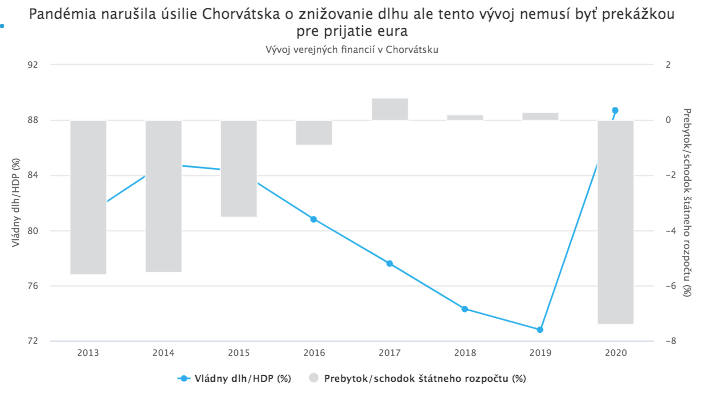
Croatia appears to be on track to satisfy the requirements. In theory, the main risk could come from public-finance criteria, as the pandemic interrupted the previously declining trajectory of the debt-to-GDP ratio and pushed the budget into deficit after three years of surpluses. But this challenge is common across the EU, and both the European Commission and the ECB factor pandemic-related distortions into their assessments. It is therefore likely that Croatia will need to present a credible plan to reduce public debt at a satisfactory pace once the pandemic effects fade, something the country should be well positioned to do given the strength of the recovery, earlier success in debt reduction, and sizable support from Next Generation EU.
The central bank governor expects Croatia to meet all convergence criteria by the summer of 2022, paving the way for euro area entry the following year. The target date for euro adoption has been set for 1 January 2023. That timeline now appears realistic, and Croatia seems within reach of joining the euro area.
Reforms, investment, and new opportunities
A second major opportunity comes via Next Generation EU, the EU’s recovery program designed to support member states after the pandemic. Relative to GDP, Croatia is set to be the largest beneficiary of the grant component of the Recovery and Resilience Facility, receiving resources equivalent to roughly 12% of GDP.
Croatia’s National Recovery and Resilience Plan has already been approved by the European Commission. It combines an ambitious reform agenda with spending aimed at upgrading infrastructure and modernizing the economy. The government’s incentives to implement reforms and use the funds productively are reinforced not only by the objective of adopting the euro quickly, but also by the pandemic’s reminder of the risks associated with excessive dependence on tourism.
At the same time, the pandemic has created a new structural opportunity. Border closures, lockdowns, production disruptions, the growing importance of e-commerce, and sharply higher shipping costs have pushed many multinational firms to rethink supply chains, improve resilience, and move parts of production and logistics closer to end markets. Croatia could benefit meaningfully from this trend thanks to its geographic location and already developed logistics infrastructure. EU-funded investment in infrastructure as well as euro adoption, which reduces transaction costs and frictions in trade, could reinforce this advantage.
Croatia is therefore an economy with significant unrealized potential, and the probability of realizing it has increased materially. If it takes full advantage of the opportunities now available, it could become one of the most dynamic economies in the region over the coming years.