Demography and Its Impact on Pensions

Fertility trends and life expectancy are frequent subjects of political debate and of opportunistic “family” policy, yet few effective measures are actually implemented to raise birth rates or to improve health span and longevity. In Slovakia neither issue has been treated as a genuine policy priority. It should be noted, however, that global change is under way and low fertility is not solely the product of political choices.
Developed and developing countries
Global trends indicate that many young people in today’s modern societies prioritise careers, travel and lifestyle experiences, postponing parenthood until later ages. This pattern is most pronounced in highincome countries. Lower fertility puts pressure on future pensioners: in the event of adverse demographic developments, pension benefits will be correspondingly lower. At the same time, increases in longevity further challenge pension system sustainability by extending the period over which benefits must be paid.
Fertility remains higher in many developing countries, although these countries are also beginning to experience gradual declines. As a result, the entire world is slowly moving toward fewer births. In 1960 the global total fertility rate (TFR) was about 5 children per woman. Today it stands at roughly 2.4. Significant divergences persist between developed and developing regions: the EU’s TFR is around 1.5, the United States about 1.6, while SubSaharan Africa still averages approximately 4.6. Even their fertility has been on a downward trajectory. Peak TFR in the global South reached about 6.8 per woman in the 1970s.
Fertility in the EU and Slovakia
In 2020 the EU’s average fertility rate was 1.5 children per woman, corresponding to approximately 4.07 million births. This continues a gradual decline that began in 2008 after several years of growth since the 1990s. Slovakia shows a very similar trend. Despite the falling TFR, the EU population has continued to grow—an effect driven by two main factors: substantial immigration and steady improvements in life expectancy.
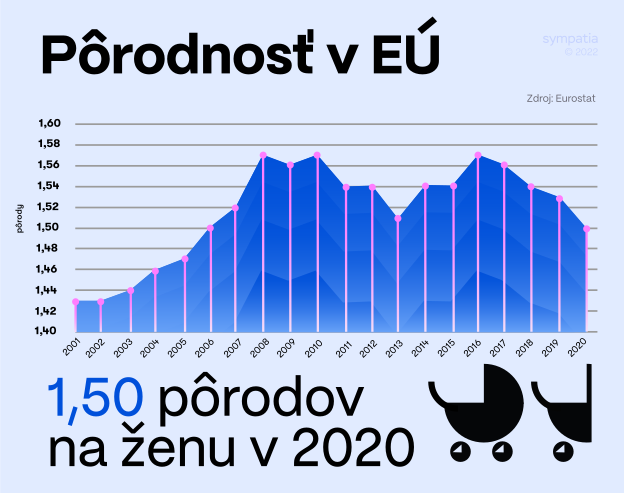
Within the Union there is variability: France recorded the highest TFR at 1.83, while Malta had the lowest at 1.13. An increasing share of births are to mothers who originate from other EU countries or from outside the Union; in 2020 such births represented about 21% of total births in the EU. Slovakia’s proportion of births to foreign mothers was among the lowest at roughly 2%.
Life expectancy in the EU and Slovakia
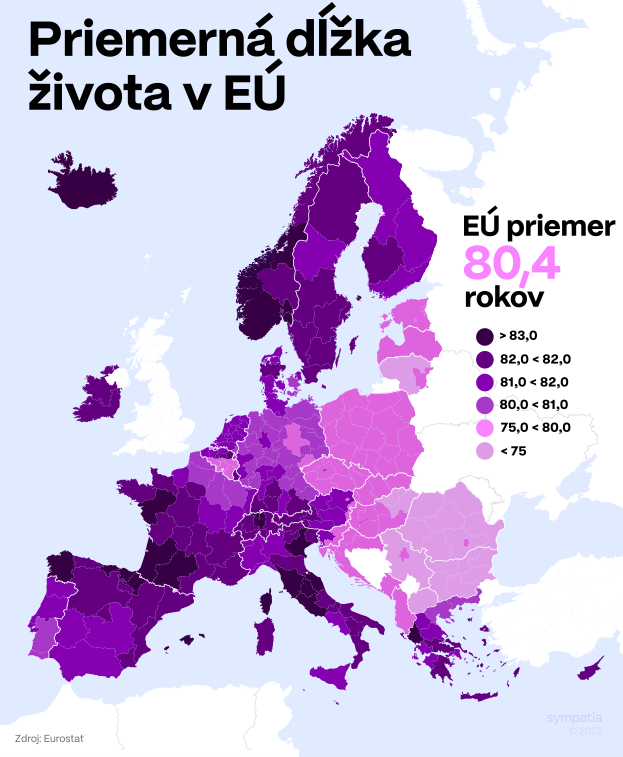
Life expectancy also substantially affects the demographic mix. In recent decades life expectancy in the EU rose steadily as a result of medical progress, higher standards of living and relative peace. Female life expectancy exceeds male life expectancy by an average of 5.7 years. In 2020 average life expectancy was about 77.5 years for men and 83.2 years for women in the EU. Slovakia recorded lower figures: 73.5 years for men and 80.2 years for women.
The highest life expectancies are observed in wealthier regions of Europe and in southern maritime countries. Iceland leads with a life expectancy above 83 years. Selected regions of Norway, France, Portugal, Spain, Italy, Greece and Switzerland also score highly. The lowest values are found in Bulgaria (with some areas around 72.1 years), Romania and eastern Hungary. Reduced life expectancy is also an issue in the Baltic states, the Visegrád group and much of the Balkans, where figures typically range between 75 and 80 years.
In 2020 the EU’s average life expectancy fell to 80.4 years—a yearonyear decline of nearly one year after a long period of gains averaging roughly two years per decade since 1960. Preliminary data suggest the adverse trend persisted in about half of EU countries into 2021, largely because the COVID19 pandemic disproportionately affected older people. Slovakia and Bulgaria experienced the largest declines in life expectancy in 2020, both around 2.2 years.
Demographic effects on pensions
Pension age in Slovakia has been progressively increasing. Retirement entitlement currently depends on satisfying legal conditions, including a minimum contribution/insurance period (at least 15 years) and reaching 63 years of age. A statutory cap on retirement age remains at 64. Women who have raised one or more children may be eligible for earlier retirement.
It should be observed that the statutory cap on retirement age is likely unsustainable and could be removed in the near future. If retained, such a cap would effectively reduce future pension levels. Slovakia previously used a more automatic, demographicresponsive system—often described as a pensionage “automatic” rule—linking retirement age to life expectancy. Such a mechanism is more sustainable because it adjusts to demographic fluctuations.
Another issue is the uniform statutory retirement age for men and women, even though women have higher life expectancy and therefore typically receive pensions for longer periods. Any policy debate about different retirement ages by sex would provoke strong controversy and charges of discrimination. As a result, sexbased differentiation appears politically unrealistic. Policymakers should focus on less contentious measures to improve pension adequacy and sustainability. For example, making participation in the second pension pillar mandatory and automatically assigning savers to more dynamic investment strategies—allowing switches only at older ages (for example, 55) or not at all—could increase longterm returns, provided professional governance oversees the process.
Another reality is Slovakia’s low labourforce participation. According to the Institute for Financial Policy, roughly 500,000 additional workers would be required to materially raise living standards and thereby increase pension levels. Slovakia does not have that many unemployed people seeking work, so the state should concentrate on creating the best possible business environment, enabling managed immigration and investing in science and education to expand the domestic labour base.
Unsustainability risks
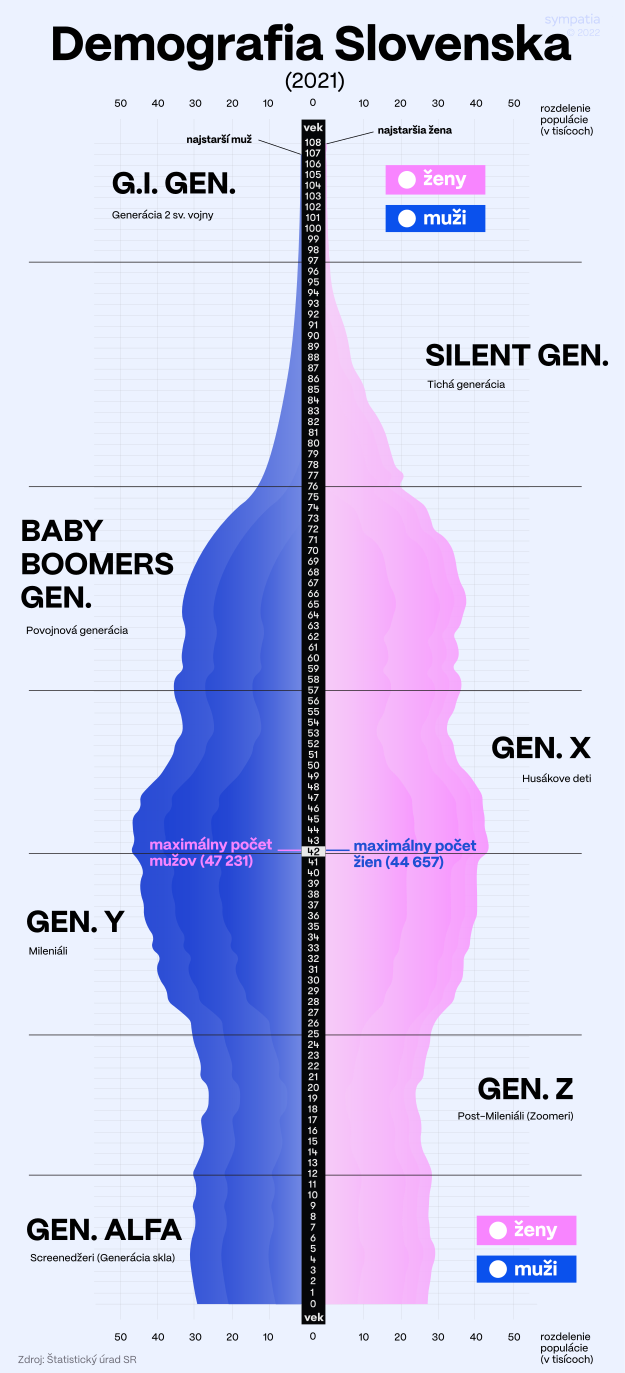
Demographic cohorts born immediately after the 1989 revolutions will face major financing challenges when the older, large cohort known as the “Husák’s children” (those roughly aged 37–52) enter retirement in large numbers. This older cohort is considerably larger than the generations born after them, creating a severe dependency imbalance in roughly two decades when a large proportion of the population reaches pension age while fewer workers remain active. This will probably be the most severe stress test for Slovakia’s pension system since the establishment of the republic.
Automation and robotisation could further depress employment, exacerbating pension financing pressures. Responses might include taxing automated capital or relying on the historical pattern in which new types of employment emerge following past industrial revolutions. Considering all factors, managed immigration appears the most realistic short to mediumterm solution for Slovakia: it could offset low fertility and increase the workertoretiree ratio. However, Slovak public attitudes are generally not open to immigration, and such perceptions are unlikely to change overnight.
Read the previous articles in this pension series: Part 1, Part 2, Part 3.