Inflation - How It Arises and Who (Doesn’t) Benefit from It?
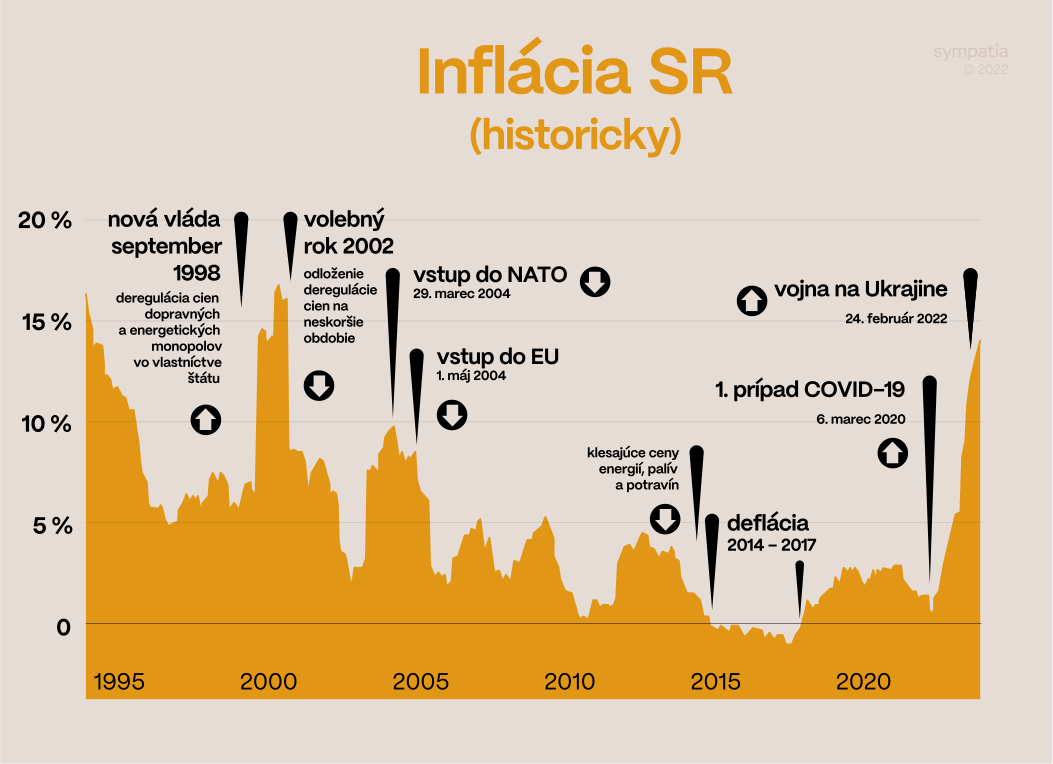
Inflation rates worldwide have reached multi year highs, and the inflation in Slovakia mirrors this trend. The last time we saw comparable figures was around the turn of the millennium. Why did inflation spiral out of control, and who has contributed the situation? The origins of today’s record inflation can be traced back to 2020, when the coronavirus pandemic paralysed the world. The current peaks, however, are mainly attributable to the war in Ukraine. Both crises were also leveraged by certain firms with professional management and market dominance. At the same time, an energy crisis emerged and was used by speculators on commodity exchanges.
An alternative perspective on inflation
The textbook definition depicts inflation as the erosion of money’s purchasing power when overall prices in the economy rise. How does that unfold in practice? Inflation increases when firms raise the prices of their goods and services. Sometimes this reflects higher input costs; at other times it results from the use of dominant market positions. Companies must set prices with reference to market prices: if an item sells for €10, you generally cannot charge €20 unless you possess a strong competitive advantage or dominant position (for example: Apple).
A different scenario can also occur: if competitors produce at a cost of €8 per unit while one producer can make it for €4, the margin can be used to squeeze out rivals or to substantially increase profits. The pandemic and the current environment, however, do not indicate that input cost optimisation alone explains price increases. Rather, key firms capitalised on market anomalies, using their scale and market power to raise prices. This expanded profit margins and translated price increases into higher profits without a commensurate rise in the cost of generating those profits. Months later, these elevated prices began to spill over into other goods and services— for example, higher transport and energy costs affect almost the entire economy and ultimately feed into rising inflation.
Inflation during the pandemic
Inflation in the euro area had been low for many years and hovered around 1% at the start of the pandemic; Slovakia experienced similarly low inflation during the past decade. The European Central Bank (ECB) had struggled to lift inflation to its 2% target. When the pandemic struck and economies shut down, inflation fell further and the eurozone even experienced a brief period of deflation. After the initial shock abated, inflation began to rise again. The first drivers included firms that perceived an opportunity in partially closed economies and increased prices accordingly.
Sectors that profited from the crisis
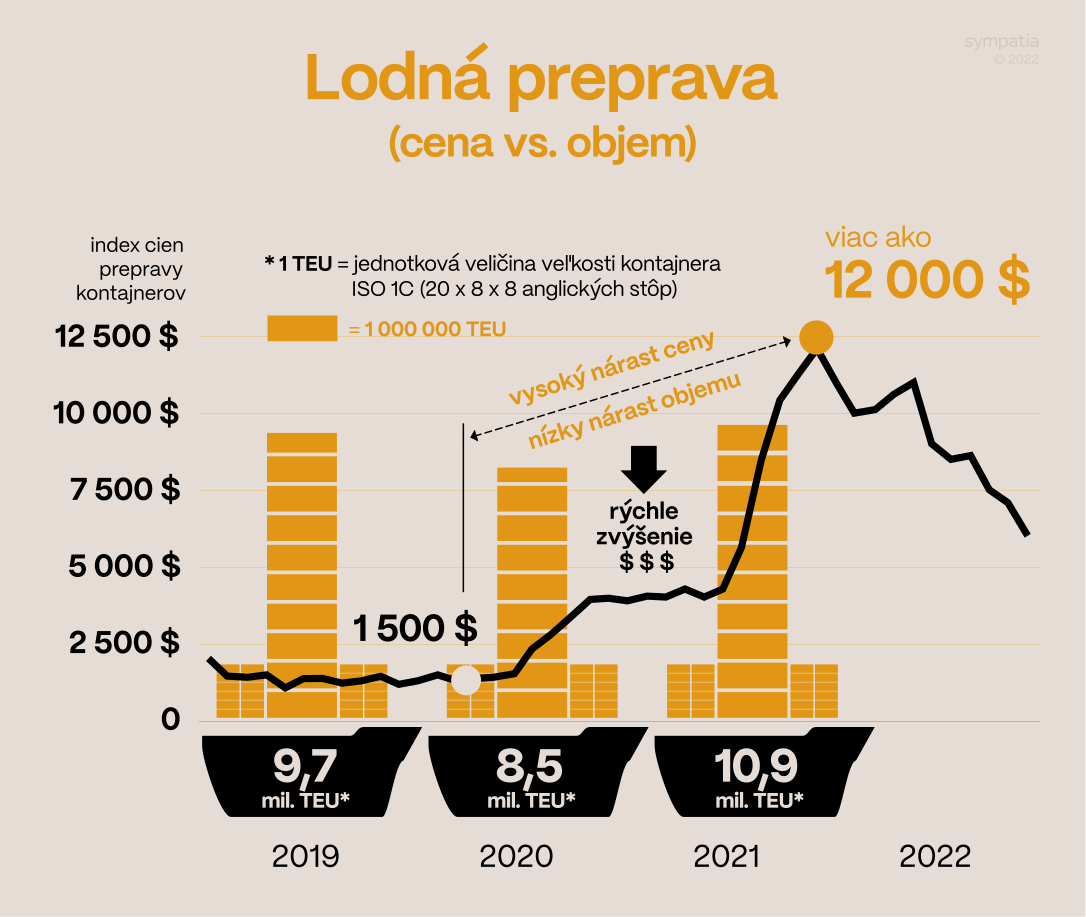
As people spent more time at home and worked remotely, demand surged for logistics, online retailers and IT services. Examples of excessive profits are evident. Shipping company Maersk, which had relatively stable revenues for years, increased revenue from €34.86bn in 2020 to €52.28bn in 2021; EBITDA rose from €6.9bn to €20.21bn. In percentage terms, roughly 76.4% of the incremental revenue translated directly into EBITDA. How was this achieved?
Maersk is one of the world’s largest shipping companies with strong management and a dominant market position. According to container shipping price indices, the cost to ship a container from Shanghai to Los Angeles was about $1,500 at the start of the pandemic; the price peaked in September 2021 at slightly over $12,000. Prices have since fallen and in recent months have decreased substantially, but they remain higher than prepandemic levels.
Other examples
Similarly profitable winners emerged in the technology sector. Zoom’s revenue rose from $595.2 million in 2019 to $4.03 billion in 2021, and EBITDA grew from $80.1 million to $1.26 billion — another instance of revenue growth being converted into outsized profits. Amazon increased revenue by $189.3 billion during the pandemic to $469.82 billion, with EBITDA rising from $30.46 billion to $48.36 billion and gross profit climbing from $114.99 billion to $197.48 billion.
Acceleration of inflation
By mid2021 it appeared inflation might slow in 2022, but Russia’s manipulation of energy supplies toward the EU beginning in late 2021, culminating in the invasion of Ukraine, altered that outlook. Curtailment of gas deliveries created enormous upward pressure on energy commodity prices in Europe. Russia then intensified the energy dispute as part of the war, further restricting gas flows — a commodity that is particularly hard for the EU to replace quickly. The conflict and sanctions amplified uncertainty and supply constraints.
At the same time, recent events damaged the Nord Stream pipelines, removing hopes of a quick revival of those flows to Germany. Consequently, the EU has had to source gas from alternative markets. That said, the EU has substantially reduced its dependence on Russian gas: current imports from Russia account for roughly 8% of EU supplies versus about 40% previously. With demand reduction targets and new supplies and infrastructure coming online, gas prices could ease further as alternative sources and contracts take effect.
Exploitation of the situation by speculators
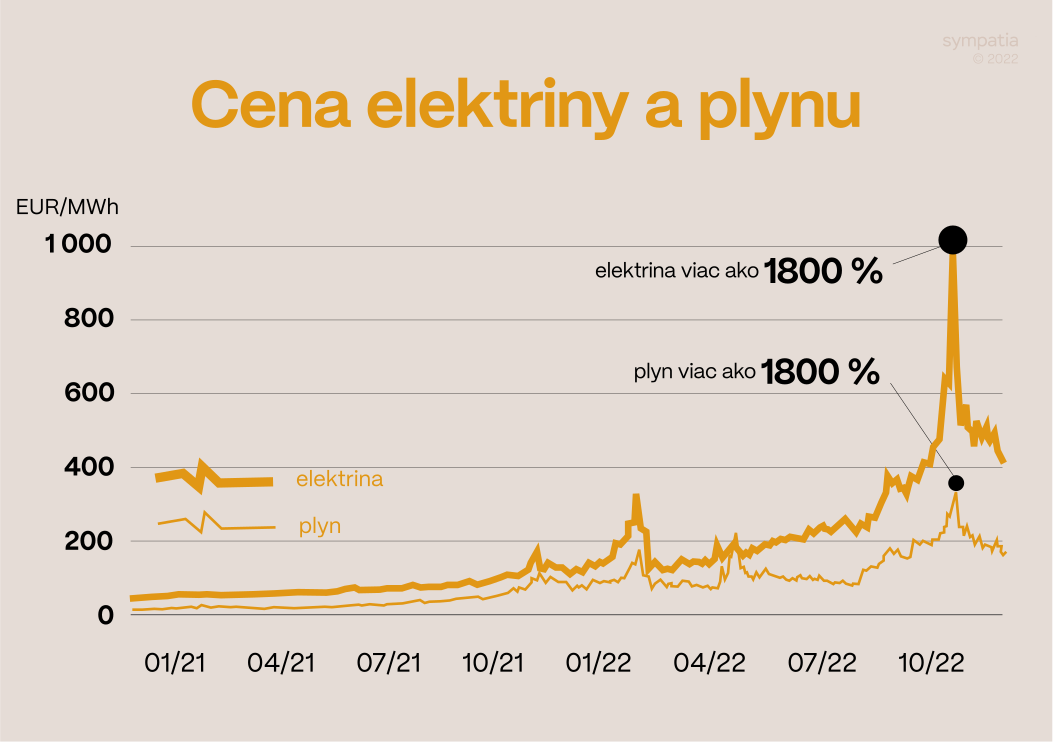
The problem is that market panic was leveraged by speculators, who bought energy at low prices and then pushed gas and electricity prices to extreme levels on poorly regulated markets. Small traded volumes on exchanges allowed traders to drive prices up sharply under stress. At moments during the crisis, gas prices traded at levels more than 1,800% above precrisis values; electricity prices also spiked by similar multiples in some periods.
Windfall profits in the energy sector
Few sectors will likely match the profitability surge seen in energy this year. Consider oil producers and electricity generators: ČEZ, the Czech Republic’s largest power producer, had stagnant revenues for years but began to post strong results in 2021 due to the factors above. Estimates suggest ČEZ may increase revenues by €4.56bn over its 2020 level (a 55.8% rise) and expand EBITDA by €2.13bn (an 88.7% increase). Production costs have not risen proportionately, which means most of the gain accrues to profits.
End of inflation = resolution of the energy crisis?
National adhoc measures are insufficient and may even deepen the crisis; a coordinated response at EU level is essential. Immediate priorities include regulating energy exchanges to prevent excessive volatility in strategically important commodities and reconsidering the pricing mechanism that ties electricity prices directly to marginal gas prices.
The EU has agreed on some measures. Leaders found consensus on an electricity price cap of €180 per MWh, with proceeds above the cap to be used by member states to support households and businesses. This cap, however, will not apply to electricity produced from gas. Additional agreements include peakconsumption reductions and a 33% “solidarity” tax on extraordinary profits from fossil fuels for this and the next year. The tax base will be the average profits over the past four years, and the tax will apply to profits exceeding 120% of that baseline.
Systemic solutions alone are not enough
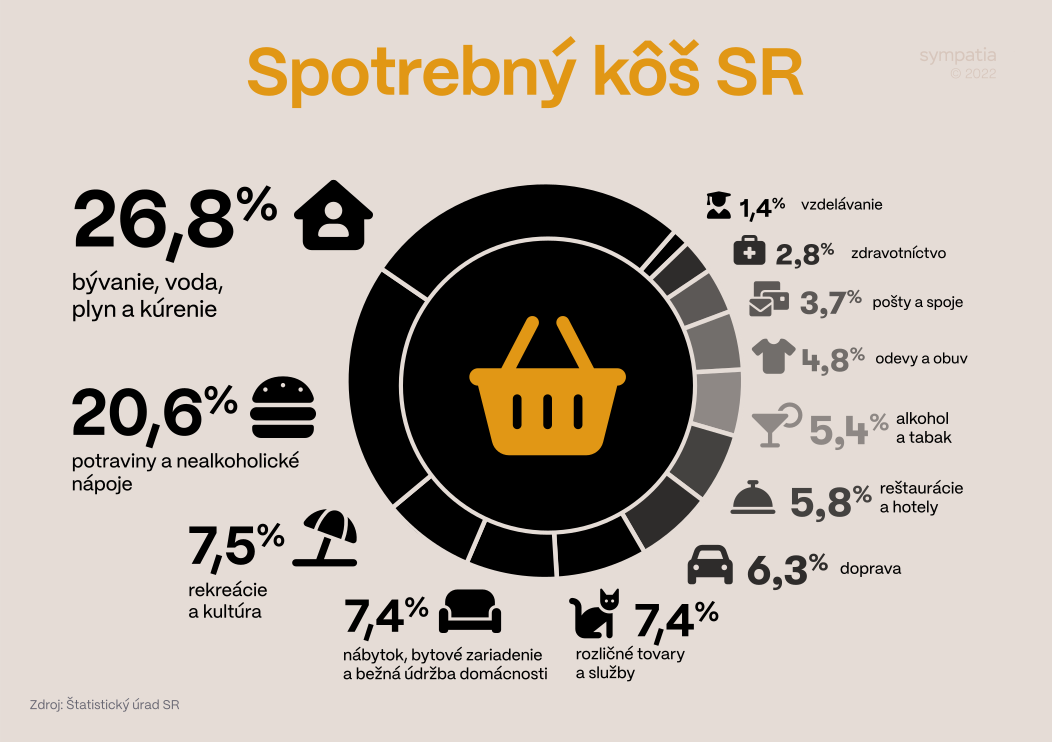
Individual action matters, too. Households consume roughly 28% of the EU’s energy, industry 26.1%, transport 28.4%, services 13.7%, and the remainder other sectors. Citizens therefore have a tangible role in easing the energy crisis: reducing gas and electricity consumption during periods of high prices helps relieve market pressure and thus inflation.
Marketconsistent behaviour will create real pressure to lower prices. Broad subsidies are popular politically but will not solve — and may even aggravate — the energy crunch. A 15% reduction in energy use by households and businesses could substantially determine the depth and duration of the crisis. Conservation measures across services, clothing, electronics, food and other products also matter, because every product requires energy to produce, distribute and sell. These synergistic effects are often overlooked.
Disclaimer
All texts, images, graphics and other objects placed in this document are protected by copyright and may not be copied, distributed, modified or made available to third parties without prior written consent of Sympatia Financie, o.c.p., a.s. This document contains general information only. Sympatia Financie, o.c.p., a.s. does not provide professional advice or services through this document and accepts no liability for any damage arising directly or indirectly from reliance on this document.