Residential Property Prices Continue to Rise Rapidly

Data from the NBS for the first quarter showed that residential property prices in Slovakia continue to grow rapidly. Over the first three months of the year, they increased by 4.2% compared to the previous quarter. Year on year, this represents growth of as much as 15.5%. The average asking price per square meter thus reached a new record at EUR 1,930/m².
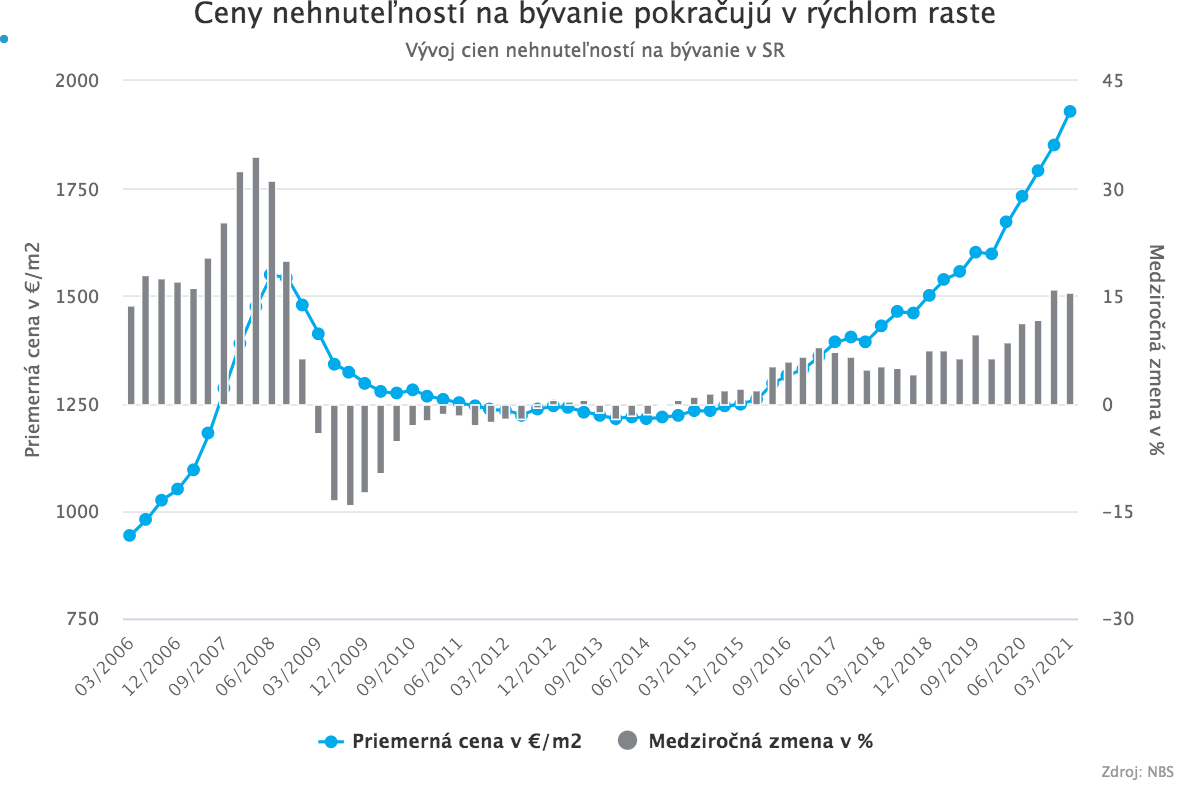
However, individual property types across different regions did not, of course, grow at the same 15.5% pace. There were significant differences between the price growth of apartments and houses, as well as between the price developments of the same property types across different regions.
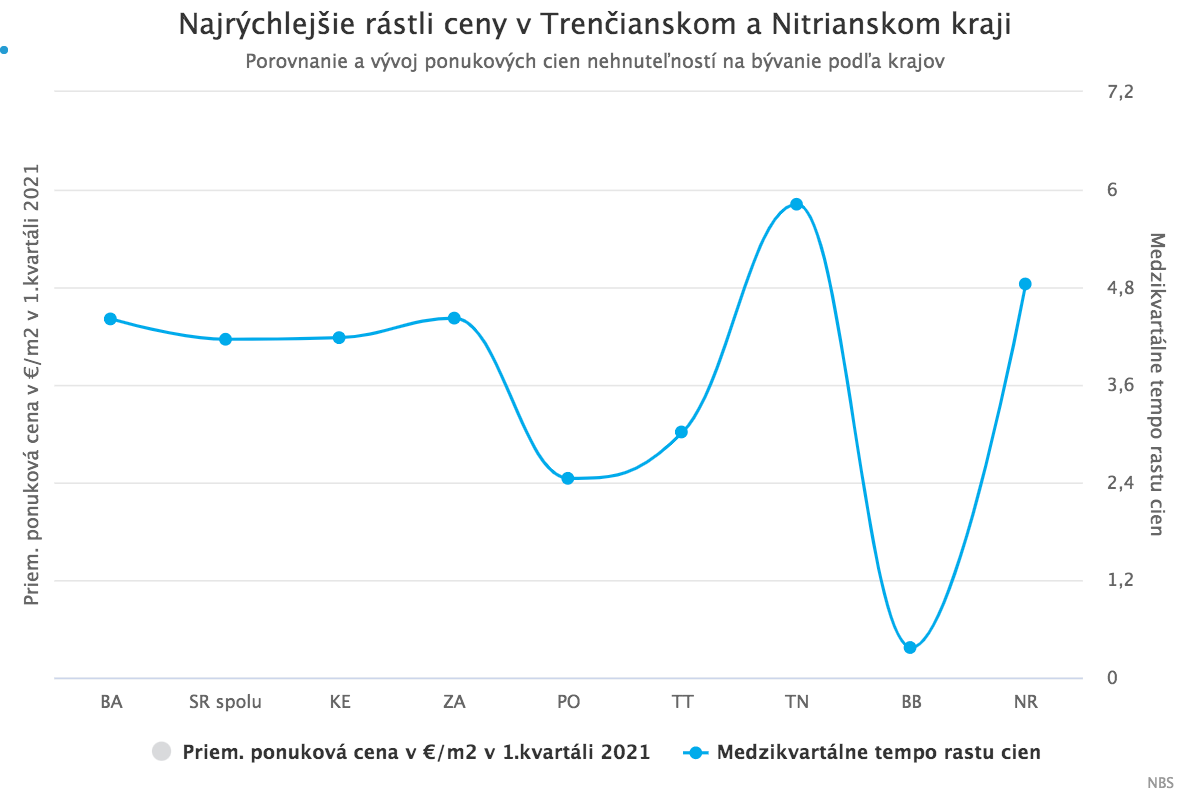
The slowest price growth was recorded in the Banská Bystrica Region
From the perspective of individual regions, we saw the strongest growth momentum in the first quarter in the Trenčín Region, where prices increased by almost 6% in Q1. A significant increase of more than 4% was also recorded in the Nitra, Žilina, Bratislava, and Košice Regions. By contrast, the weakest increase, only 0.4%, occurred in the Banská Bystrica Region.
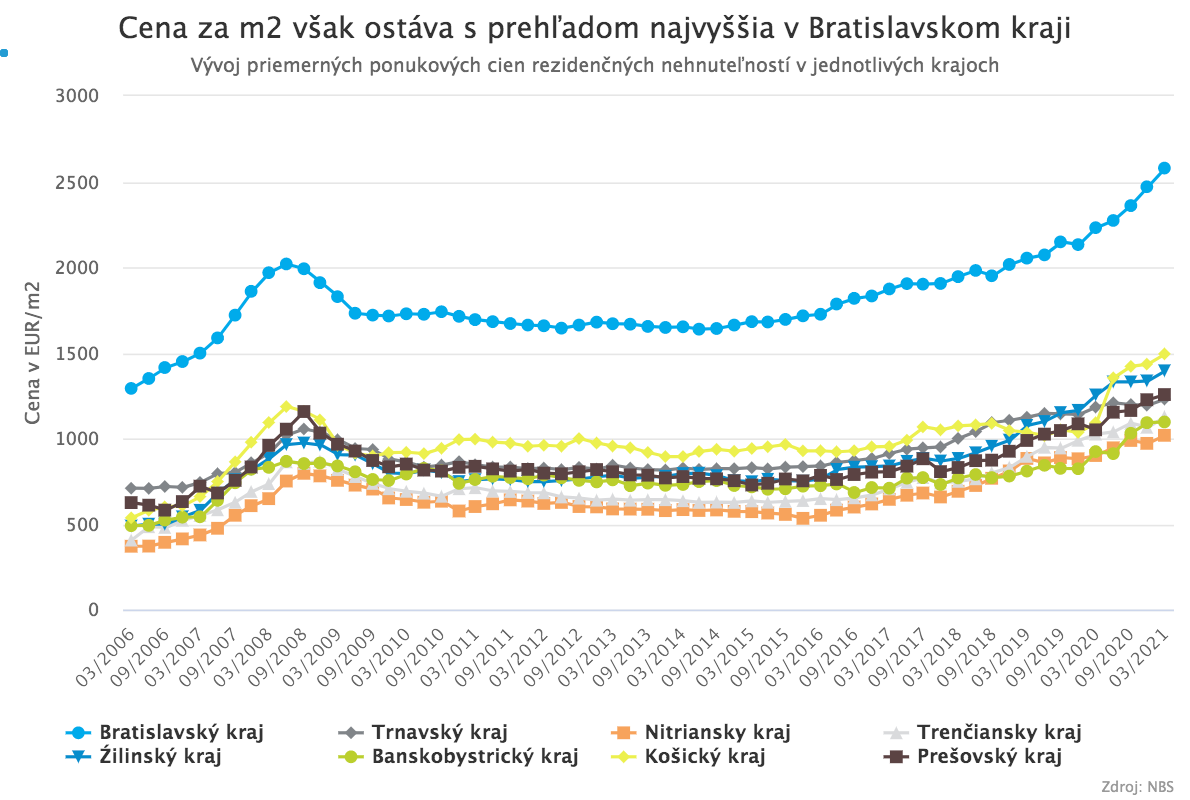
In absolute prices per square meter, however, the Bratislava Region naturally continues to lead by a wide margin, where the average price per square meter today reaches as much as EUR 2,579. In second place in recent months is the rapidly growing Košice Region, with an average price of almost EUR 1,500/m². The lowest average price, only slightly above EUR 1,000/m², was recorded in the first quarter in the Nitra Region.
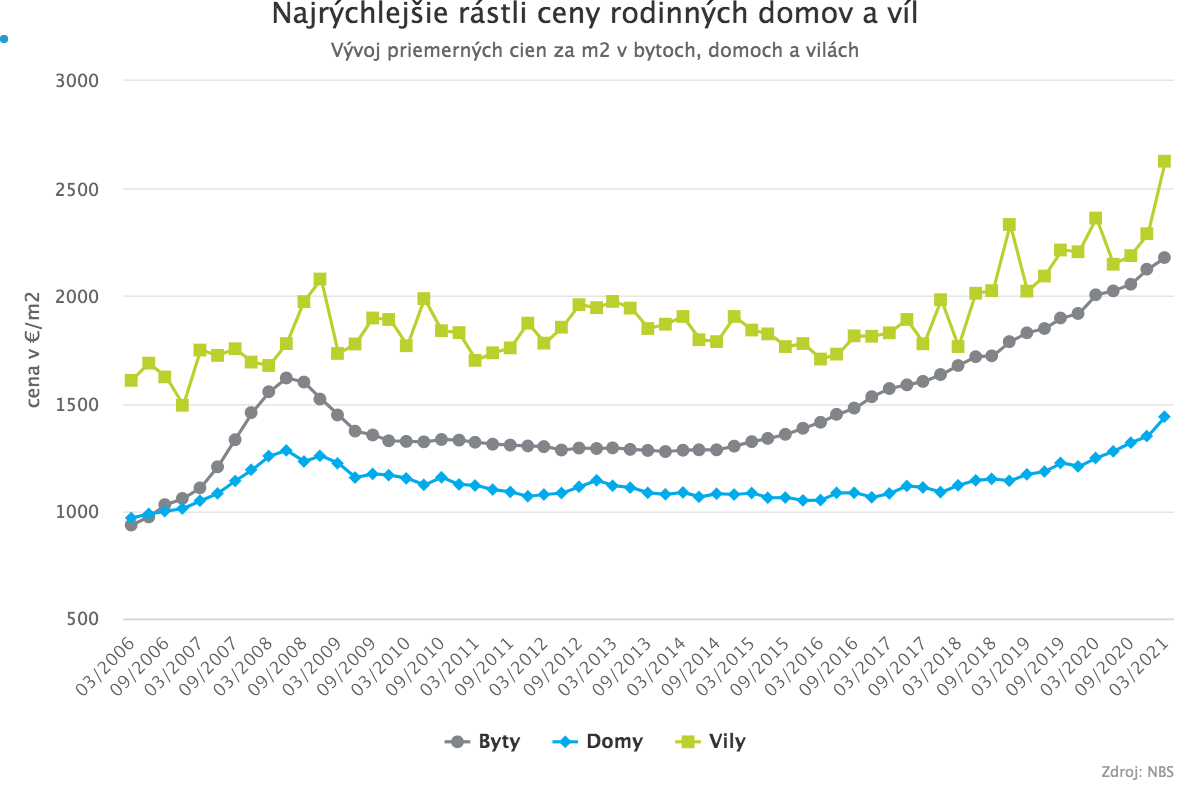
Prices of family houses and villas grew more strongly than apartment prices
Significant differences in price growth were observed not only among regions but also among property types. Prices of houses and villas increased in recent months at a markedly faster pace than apartment prices. The asking price per m² in villas rose quarter on quarter by as much as 14.7%, and in houses by 6.7%, while in apartments it increased by only 2.5%. In absolute terms, however, prices per m² for apartments remain substantially above those for houses. Villas retain the top position.
However, prices of all apartments did not grow at the same rate either. In the first quarter, the fastest growth, up to 4%, was recorded for one-room apartments, which also registered the largest price increase on a year-on-year basis. Large apartments with five or more rooms, by contrast, were the only category to record a price decline. Compared to the previous quarter, their price fell by as much as 4.8%. On a year-on-year basis, however, this has so far represented only a 1.5% decline.
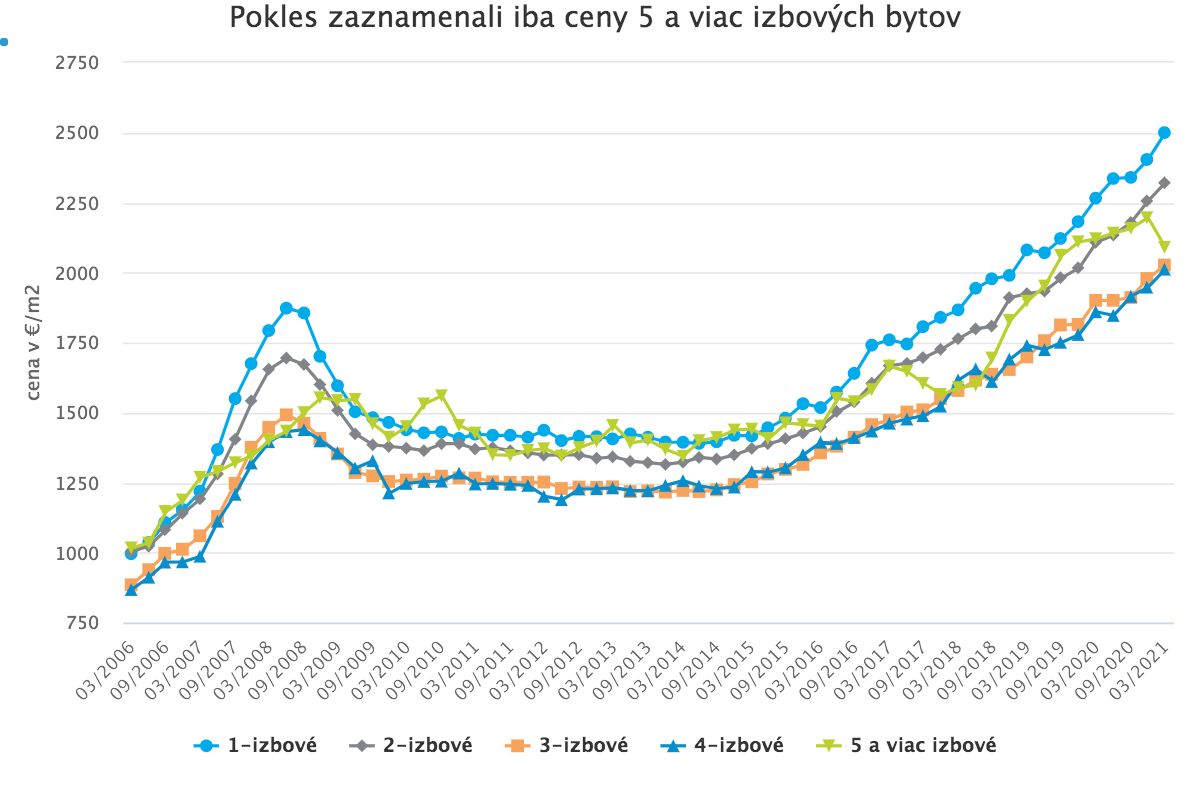
The price per m² in apartments with five or more rooms is thus gradually declining toward the level of three- and four-room apartments, while in the smallest one- and two-room apartments it continues to rise rapidly.
Will prices continue to rise?
At first glance, a 15.5% year-on-year increase in housing prices seems unsustainably high, especially when we consider that it occurred in the middle of a pandemic that significantly disrupted the economy and hit many people hard. Is this therefore a bubble, and are we facing a decline in property prices as after the major financial crisis in 2009? A closer look at the factors that contributed to this rise in prices suggests that this will not be the case. On the contrary, it seems highly likely that housing prices in Slovakia will continue to rise significantly, at least over the next few years. Residential property prices in Slovakia have in fact been driven upward for several years by the interplay of several factors on both the supply and demand sides, and so far it appears that the pandemic has not changed this dynamic. It may even strengthen it further and intensify upward pressure on prices.
Insufficient supply of apartments
One of the most important long-term factors pushing prices upward is the insufficient supply of housing. If you live in one of the densely built-up parts of a city, you may easily get the impression that there are enough apartments and houses in Slovakia, or even a surplus, but the opposite is true. In Slovakia, given the population size and existing demand, there is a long-term shortage of residential property. Slovakia ranks near the bottom of Europe in the number of dwellings per 1,000 inhabitants.
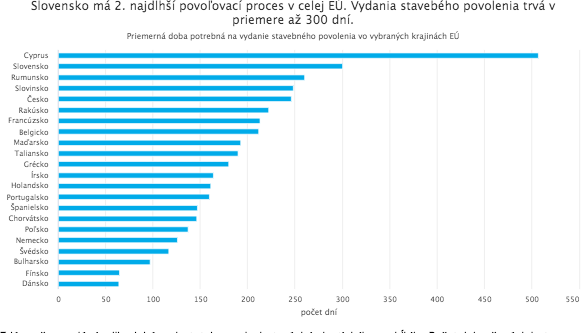
The situation in this regard is particularly critical in large cities, especially in Bratislava, where the pace of new housing construction significantly lags behind population growth. In Bratislava, there are 385 apartments per 1,000 inhabitants (with habitual residence). This is slightly above the national average, but far below the European average, and even far below the level of nearby capitals, which themselves are below the European average. Prague and Warsaw report 463 and 478 housing units per 1,000 inhabitants, respectively; Budapest and Vienna even as many as 524 and 574. This long-term shortage of housing supply has several causes that are not easily addressed, and no significant improvement can be expected in this respect over the next few years. One of the most significant factors constraining the addition of new housing units is lengthy and time-unpredictable permitting processes. Issuing a building permit in Slovakia takes on average up to 300 days. This is the second worst time in the entire EU.
It appears that the pandemic has only deepened the long-term shortage of housing units. Although the number of completed apartments increased slightly last year compared to the previous year, the number of started apartments recorded a drop, and the number of issued building permits also declined. According to NBS data, construction of residential buildings in the first two months of this year was up to 10% lower than last year. Insufficient housing supply will therefore likely continue to put upward pressure on prices in the coming years.
The pandemic may not significantly weaken demand
The pandemic may not significantly weaken demand
In addition to insufficient supply, long-term strong demand also supports rising property prices in Slovakia. This demand is the result of several factors, while the pandemic had a potentially negative effect only on some of them. Over the long term, demand for property in Slovakia is supported, on the one hand, by demographic trends, especially shrinking household size, which is a Europe-wide trend and is gradually beginning to manifest itself in Slovakia, and, on the other hand, by economic factors such as low mortgage interest rates and rising living standards. There are good reasons to assume that the pandemic will not change the long-term demographic factors supporting demand. Rather the opposite may be true. It is likely that the rise in working from home and the overall increase in time spent at home leads many people to the need to establish independent housing arrangements or to secure a larger, more comfortable, or otherwise more suitable living space. Among the most important economic factors strengthening demand for property in recent years have been declining mortgage interest rates and rising living standards. As can also be seen in the following chart, mortgage interest rates in Slovakia have been declining over the long term and are currently at record lows. Their level is primarily determined by the ECB’s main policy rate, which, also due to the impact of the pandemic on the economy, will likely not be increased for several years. The ECB would raise rates only if the economic recovery after the pandemic were unexpectedly fast and strong and put upward pressure on inflation. Such a scenario is not among the most likely; and even if it were to occur, from the perspective of demand for property, the benefits of a rapidly growing economy would likely easily outweigh the negative impact of higher interest rates.
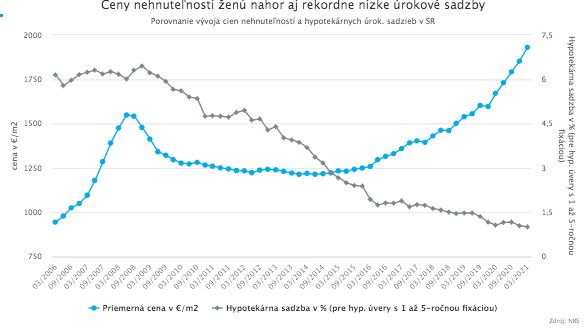
It can therefore be expected that “cheap” mortgages will continue to support demand for property. As regards improving living standards, which in recent years also stimulated demand, the situation is more complex. The pandemic, unfortunately, significantly worsened the financial situation of many households, led to higher unemployment, and contributed to a slower pace of expected wage growth. These factors lead, at least in the short term, to a deterioration in housing affordability. Whether they will have a long-term negative impact on demand will depend on the further course of the pandemic and the speed of the economic recovery. On the other hand, the pandemic also led to a significant increase in savings accumulation among a large part of the population. It is likely that as soon as the increased economic uncertainty associated with the current situation subsides, these accumulated savings will become the basis for investments that will, to a significant extent, also be directed into real estate. It can therefore be expected that, as a result of insufficient supply and continued demand supported by demographic trends and, at least in part, by economic factors, residential property prices in Slovakia will, with high probability, continue to rise in the coming years.
How to profit from rising property prices?
Persistent growth in property prices and the long-term favorable outlook of the real estate sector naturally also provide very attractive investment opportunities characterized by stable and appealing returns with relatively low risk. The most traditional form of real estate investment is, of course, the direct purchase of an apartment, for example in one of our projects. However, if your primary objective is not to secure your own housing but rather an investment, the direct purchase of an apartment or house may not always be the most suitable solution, as subsequent property management, or renting it out, requires time and additional costs. Such an investment is also associated with lower liquidity, because it is not always possible to sell the property quickly at the market price when needed. A more efficient and often higher-yielding way to benefit from rising property prices is therefore an investment in a high-quality real estate fund, project bonds, or other financial instruments directly linked to the performance of the real estate market. The advantages of such investments are lower time requirements, professional management, higher liquidity, flexibility regarding the invested amount, and usually also diversification of the investment across multiple properties or projects. However, it is always necessary to verify which company offers the specific investment and carries out the related projects, how the investment is secured, and whether the investor has sufficient information about both the planned and actual development of the financed projects. At Sympatia, we offer clients the opportunity to invest in Polaris qualified investor funds, which invest in a well-diversified portfolio of attractive real estate projects in residential property, logistics, and industrial segments, both in Slovakia and in Central and Eastern Europe. Since their establishment in 2011, all Polaris funds have achieved positive absolute returns every year, with net average annual performance reaching 6%. The Polaris funds are therefore an ideal solution for clients who are interested in investing in real estate in order to achieve stable and predictable, yet above-standard returns. For investors who want to diversify their portfolio into the real estate market but do not meet the minimum investment amount required for qualified investor funds, there is the Sympatia Real Estate investment certificate. Finally, for investors who prefer bond-based investments, we offer bonds linked to specific real estate projects.